71
HEATING SYSTEMS
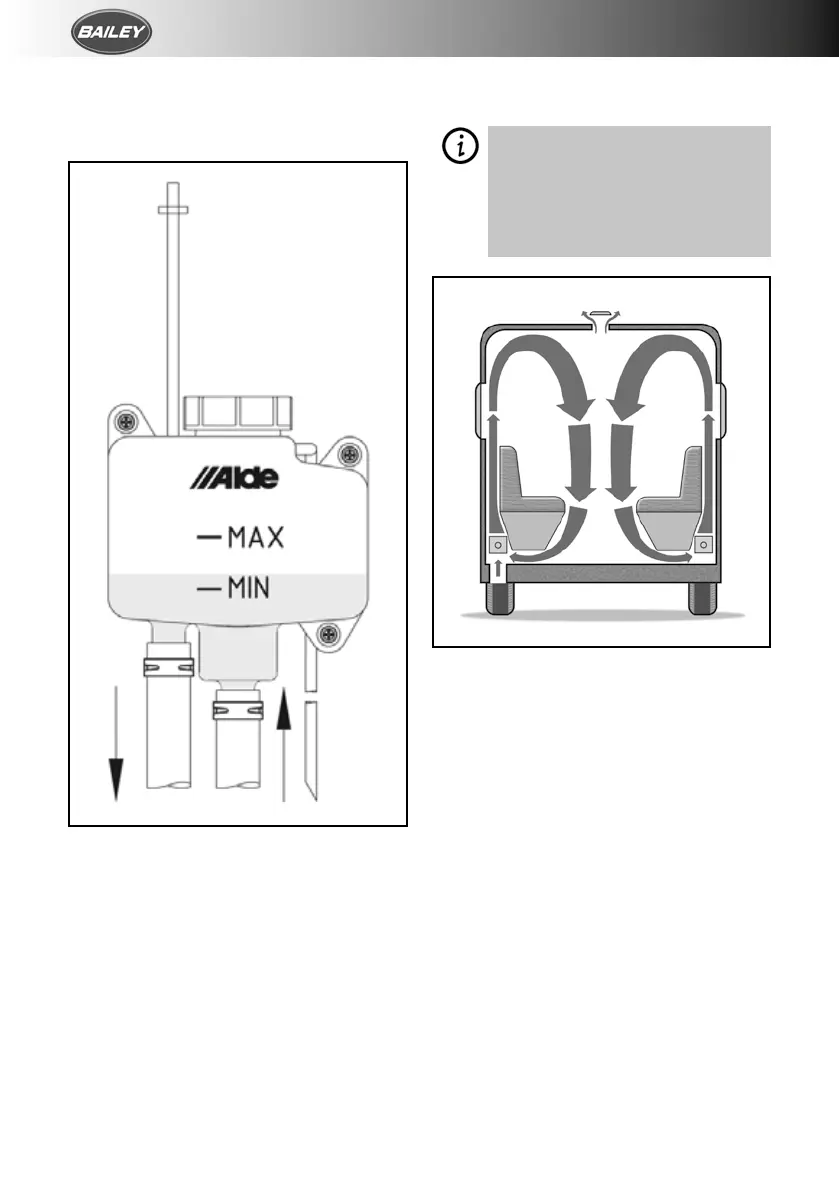
expansion tank cap (Fig.2 [R]) and remove
cap. Carefully pour the HTF into the tank, and
repeat until the fluid level is about 1 cm above
the MIN mark when cold.
Fig. 2
CENTRAL HEATING
The boiler is set to an upper limit temperature
of 85°C, i.e. the temperature of the heat
transfer fluid (HTF) as it circulates around the
pipes, radiators, convector, etc.
To ensure the best performance from hydronic
heating, air must be able to circulate freely
around the back of the furniture (Fig.3). Air
vents, cut into the top and bottom of the
furniture must be unobstructed by carpets,
cushions, or stowage, etc.
The full length of a convector should be
ventilated for best performance.
Use gas and electric heating
simultaneously for the best
performance. The boiler will only use
as much energy as is needed, and is
93% efficient on a SEDBUK (seasonal
efficiency of domestic boilers in the
UK) based test.
Fig. 3
CIRCULATION PUMP
A pump is used to circulate the HTF around the
central heating system.
BLEEDING AIR
The HTF will contain some air. This is
unavoidable. Air bubbles can also be
introduced when the system is filled.
In a newly filled central heating system you
will need to bleed air from the bleed points
to ensure best performance. There is an
automatic air bleed valve on the boiler. There is
also an air vent on the expansion tank.
The installer should fit bleed points elsewhere
in the system, especially where the pipes step
up and down, and on radiators and towel rails.
Air will accumulate at these high points and
become trapped.



 To Next Page