20
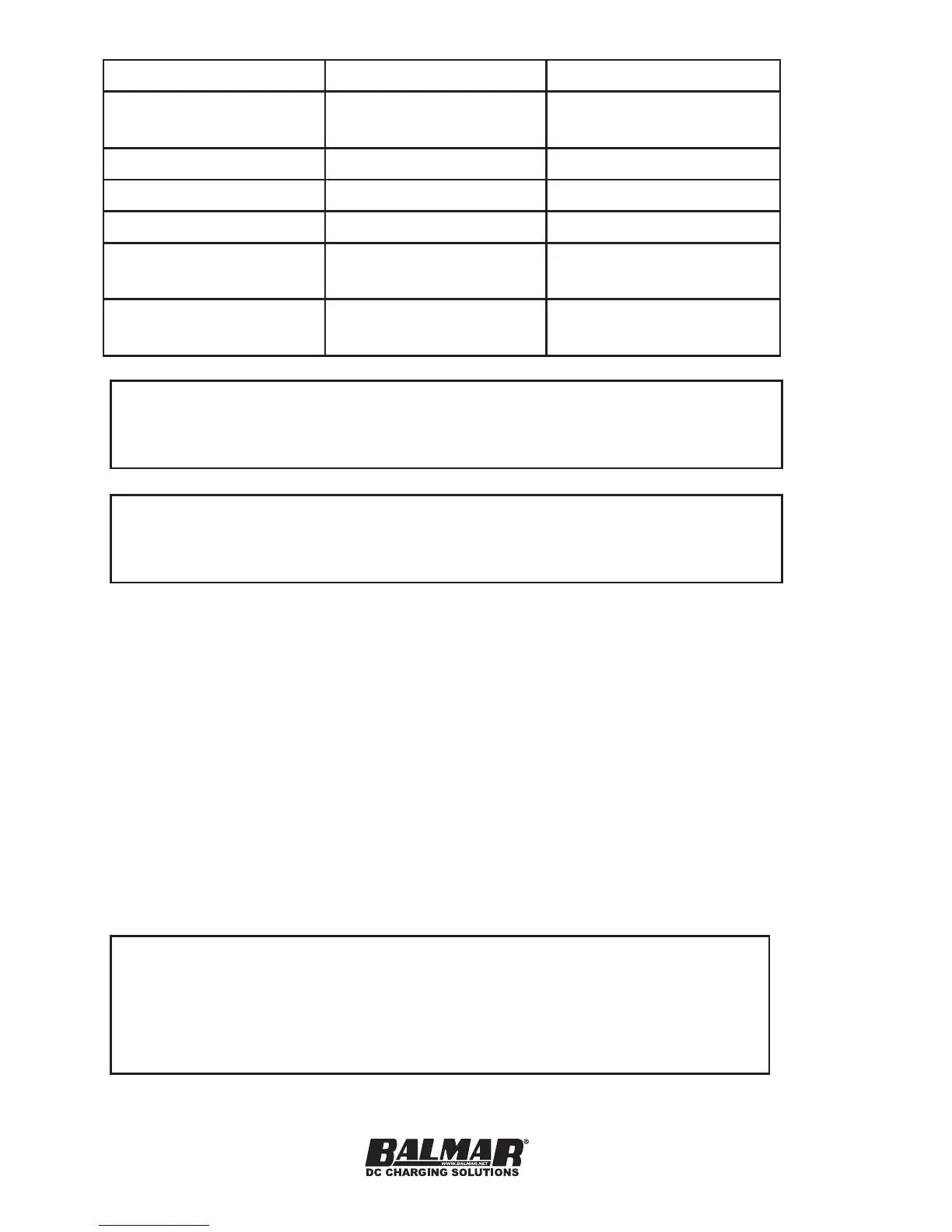
Chemistry Number Chemistry Name Description
00 FLOODLA Flooded (Wet) Lead
Acid
01 AGM AGM
02 CARFOAM Carbon Foam AGM
03 LIFEPO4 Lithium Phosphate
04 DUALPUR Dual Purpose Lead
Acid
05 AGMTPPL Thin Plate Pure Lead
AGM
NOTE: Every time a chemistry is selected, all learning is lost, even
if you re-select the currently used chemistry. This will mean that the
SG200 will need a few charge cycles to obtain peak accuracy.
NOTE: If you are uncertain which battery chemistry to select,
please contact Balmar Customer Support: http://www.balmar.
net/contact-technical-services/ or 1-360-435-6100
CAPACITY - Selecting a Battery Design Capacity
Once you select a chemistry, you must specify the capacity of the battery
bank. This is the total design capacity of the entire bank, regardless of the
battery’s condition, or previously measured capacity. Typically the capacity is
expressed as the 20-hour discharge rate. This may be written as something
like “105Ah/20h” on the battery or battery documentation. If you cannot nd an
Ah specication for your battery, but it does show a reserve capacity (RC) refer
the Appendix “Converting Reserve Capacity to Amp Hours.” CCA or MCCA
values are not describing capacity and cannot be used to determine the battery
capacity.
EXAMPLE: Consider three Group 31 batteries, each with a design
capacity of 100 amp hours. They are connected in parallel to make
a 12v, 300Ah bank. The design capacity to be entered is 300. Even
if the batteries are older, and they have diminished in capacity, the
bank capacity should always be entered as a design capacity.


 To Next Page