6
Introduction
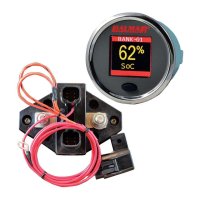
The SG-200 is a battery monitoring system. It’s purpose is to provide the user
with continuous information on various parameters of a battery or battery-bank,
and of direct current (DC) usage in the system.
Specically, it can show:
Parameter Unit
Voltage Volts (V)
State of Charge (SoC) Percent (%)
State of Health (SoH) Percent (%)
Current (A) Amperes (a)
Time Remaining Hours: Minutes
Voltages for two separate Auxil-
iary batteries
Volts (V)
What is a battery monitor, and why is it important?
Who would argue that it is not good to know how much power is left in a
battery? It is like a fuel gauge, and you would not drive a car or boat without
knowing how much fuel is remaining in the tank.
Enter the battery monitor. The most important job of a battery monitor is to
report on the State of Charge of a battery or battery bank. The State of Charge
(SoC) is a percentage value, showing what percentage of the battery’s capacity
is remaining.
The SG200 very accurately calculates the State of Charge, and it does so by
incorporating a new feature: State of Health (SoH). State of Health is another
percentage value, that compares the design capacity of a battery, or the
capacity the battery’s manufacture says it should be when new, with it’s actual
capacity, which degrades over time as a battery ages.
Accurate and continuous measurement of SoC and SoH is a breakthrough
in battery monitoring. As the battery ages, the monitor does not get less and
less accurate. Instead, the SoC value is always a percentage of the calculated
capacity taking into account the aging and other detrimental effects on a
battery’s capacity.
The SG200 also is unaffected by other issues inherent in all other shunt-based
systems, like accuracy drift over multiple partial state of charge cycles. Simply
put, traditional shunt-based products need to reach 100% charge each cycle.


 To Next Page