ENGLISH
76
Familiarization
Avalanche Awareness
Travel with considerate partners:
• Crosspotentiallydangerousterrainoneatatime.
• Identifyandpracticestoppinginsafezones.
• Haveanescaperouteinmindiftheslopedoesavalanche.
• Communicatewithyourpartnersbeforemovingontotheslope.
When traveling in a group, be aware of the errors groups
typically make:
• Recreatingatanareathat’sbeenvisitedwithoutincidentbefore
andfeelingcondentinitsstability.
• Notspeakingoutorcommunicatingconcernsaboutapath
orslope,fearingconict.
• Beingovercondentinthegroup’sabilities.
• Determinationtoreachadestinationwithoutre-evaluatingterrain
and conditions.
If in doubt, it is always best to avoid questionable terrain and return
when the snow is stable.
If you are caught in an avalanche:
• Yell“avalanche”andwaveyourarmstoalertyourgroup.
• Deployyouravalancheairbagifyouhaveone.
• Trytoescapetheslidebygrabbingtreesorrocksor“swimming”
to the side.
• Trytokeepyourairwayclearofsnow.
• Whenyoufeeltheslideslowing,thrustahandupwardinhopes
of it being seen.
• Placeyourotherhandinfrontofyourfacetoincreasethe
air space.
• Remaincalm,breatheslowlyandconserveyourair.
Searching for victims:
• Donotgoforhelp!Youarethevictim’sonlychanceofsurvival!
• Establishalastseenpoint.
• Conrmyouarenotindangerofasecondavalancheoccurring.
• Lookforvisualcluestothevictim’slocation.
• Beginyoursignalsearchforthevictimusingyouravalanche
transceiver.
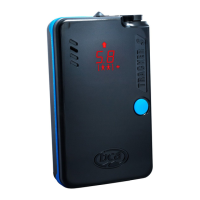
Thank you for choosing Tracker S, featuring Tracker’s legendary
ease-of-use.
Remember,transceiversearchesareonlypartoftheavalancherescue
process. It is equally important to practice the probing and shoveling
techniques found later in this section. For training videos on transceiver
searching, probing, strategic shoveling, patient care, and evacuation,
please visit www.backcountryaccess.com/education.
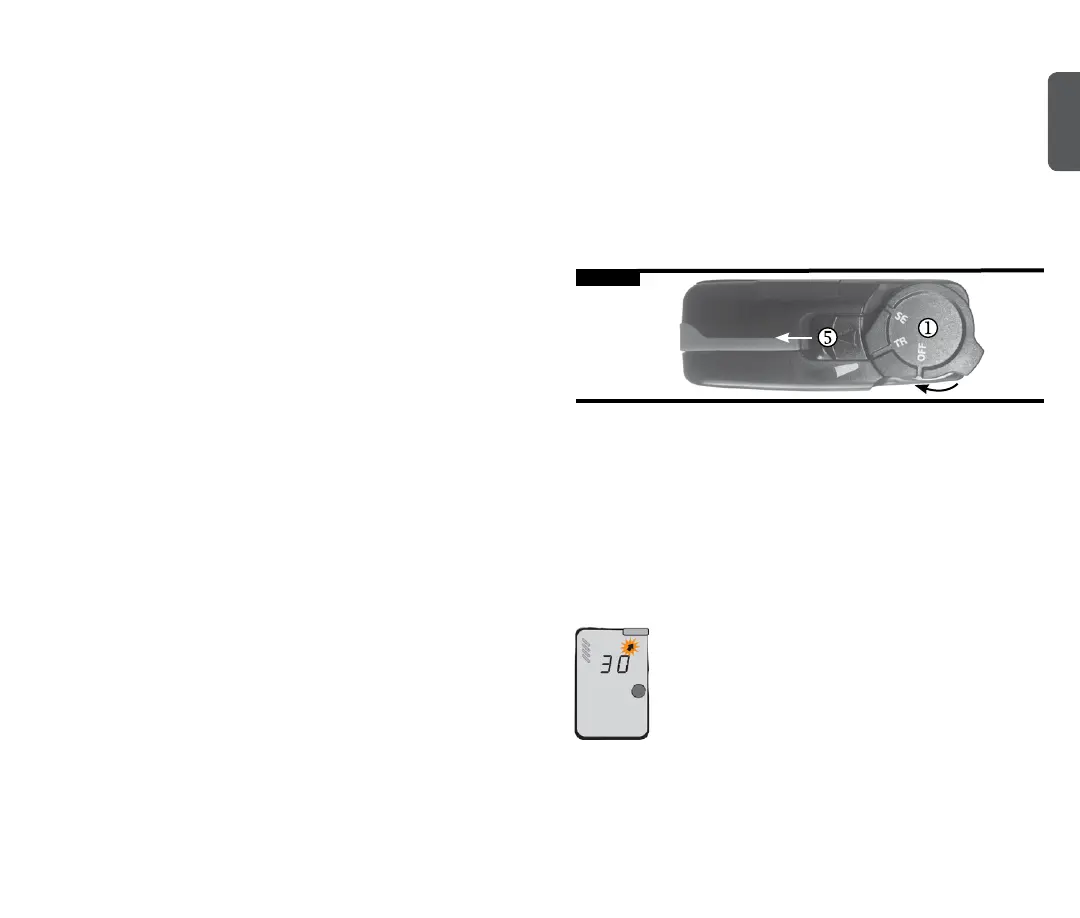
Transmit mode: Fromthe‘O’position,pulltheslidinglock
n in the
direction of the arrow and turn the dial switch
j
on top of Tracker S to
thetransmit(“TR”)position(seeFigureC).
Figure C
Top view of
Tracker S.
The battery life is then shown in the distance/battery power display
k
in Figure A.
Afterdisplayingbatterypower,TrackerSashes“TR”andenterstransmit
mode. The transmit light
l
asheswitheverytransmitpulse.
Thislightwillnotashifthebatterypowerisbelow20percent.
Note:thebatterypercentageisapproximate.Replacebatteries
m
before
reaching40percent.Batteriesthatwereinstalledinthetransceiverthe
previous season should be replaced, as they can result in misleading
battery power readings.
Whenintransmitmode,theTrackerScannotbeturnedtooorsearch
without pulling back the sliding lock.
Search mode: Pull the sliding lock
n and rotate the dial
switchtothesearch(“SE”)position.Insearchmode,the
displaywillperiodicallyash“SE”untilasignalisdetected.
Upon detecting a transmitting signal, Tracker S will begin to
display distance and directional readings. At distances of less
than two meters, the directional lights are no longer shown.
Return to transmit: When in search mode, the sliding lock does not need
to be moved in order to return to transmit mode. Simply rotate the switch
backtothetransmitposition.TheTrackerwillbeepandash“TR”before
it begins to transmit.
After30minutesinsearchmode,TrackerSwillbeepeverytwominutes.
After12hoursintransmitmode,itwillbeepeverytwominutes.Thesebeeps
are reminders that there has been no user input and Tracker S is still on.


 To Next Page