54 Bedrock SMxx operating manual © Bedrock Audio BV, 2019
9.3. Electric in RTA and FFT
Dedicated versions of the real-time analyzer (RTA) and FFT analyzer are provided specifi-
cally for analysis of electric signals through the XLR input.
The precautions mentioned above (in section 9.2) also apply here: be careful
to protect the XLR input from voltages higher than 40V, and make sure to
switch of the phantom power in the settings menu.
The RTA and FFT intended for electric input signals are used in exactly the same way as
the “ordinary” RTA and FFT (see sections 7.3 and 7.4), with one difference: the displayed
levels are relative to an electric reference signal instead of the acoustic reference of 2.10
-5
Pa.
The electric reference can be set to display all levels in dBU, dBV or dBuV (corresponding
to reference levels of , respectively, 0.7746 V, 1.0000 V and 1.000*10
-6
V).
Note that saved results are stored in separate folders (named eRTA and eFFT), separately
from results for acoustic measurement data. The SMxx is calibrated for electric inputs to
the XLR, completely separately from its acoustic calibrations. The electric calibration factor
can be adjusted in the “Calibration” module.
9.4. Polarity
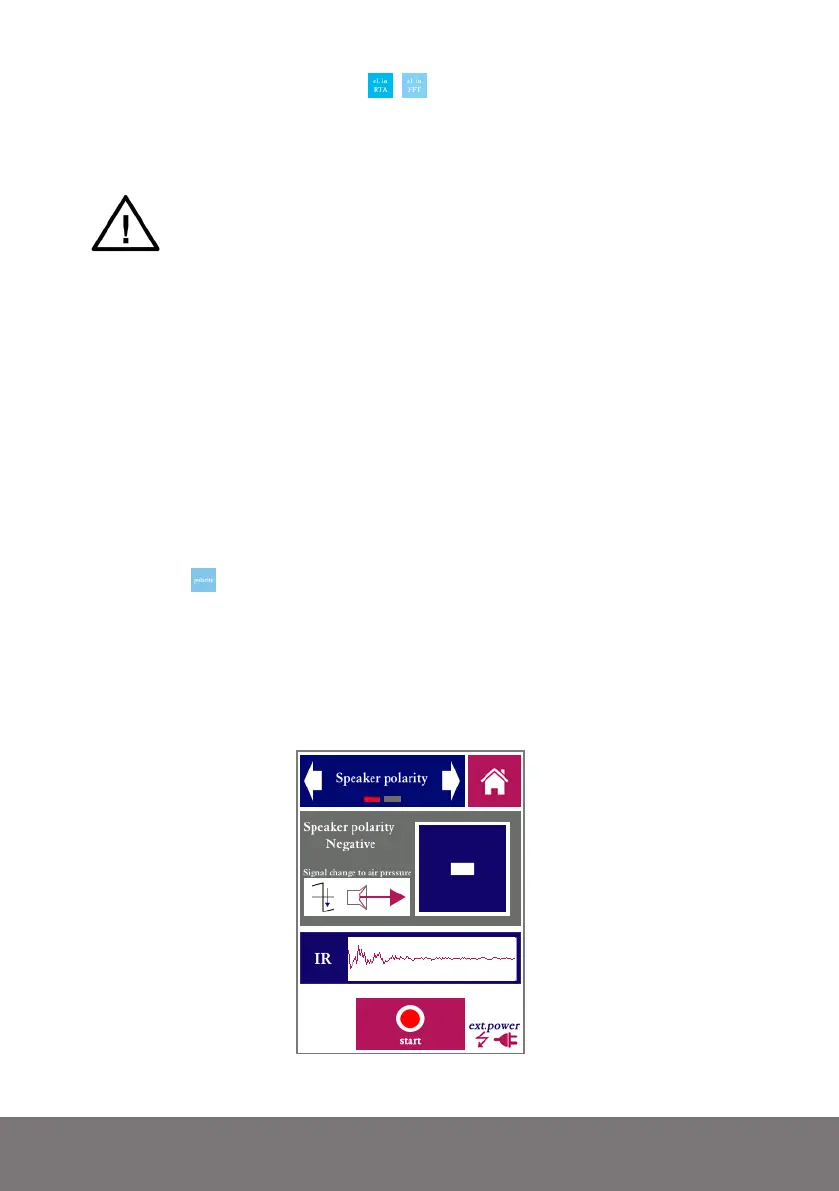
The polarity module is intended to check the polarity of loudspeakers. Polarity is important
in all systems featuring more than one loudspeakers; inconsistent wiring may lead polarity
inversions, with adverse consequences for the level and quality of sound. Note that inver-
sion of the polarity by itself is usually not a concern, as long as the polarity remains consist-
ent among all loudspeakers within the same space.
Loudspeaker polarity



 To Next Page