17
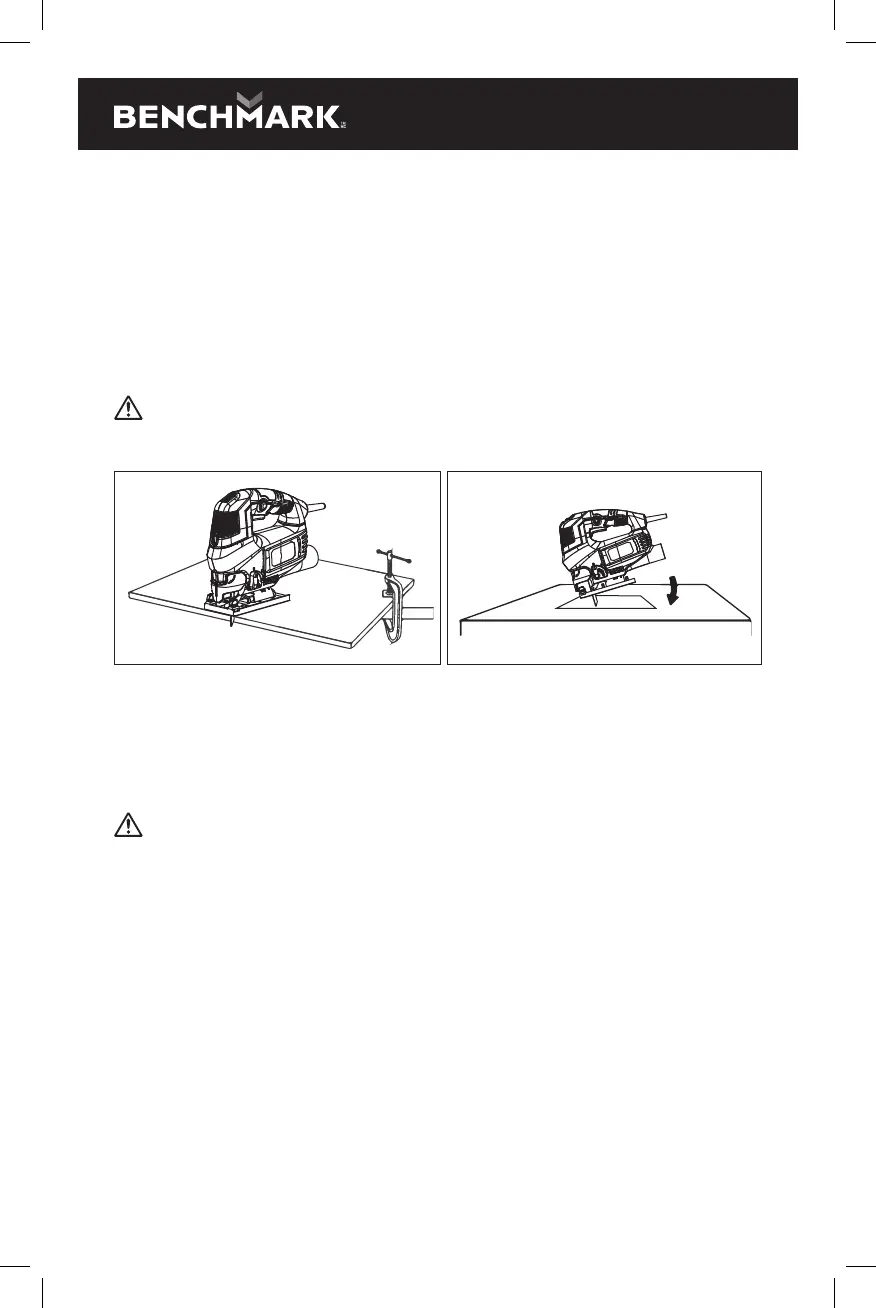
3. Rest the front of the jig saw base on the workpiece and align cutting edge of the
blade with the cutting line on your workpiece (Fig. 13). Make sure the power
cord is out of your way and not in the path the blade will follow.
4. While firmly gripping the jig saw, and with the blade NOT in contact with the
surface to be cut, start the jig saw by squeezing the trigger switch.
5. Once the jig saw has reached the desired speed, gradually bring the moving
blade into contact with the workpiece at the appropriate location.
NOTE: Apply enough downward pressure to keep the jig saw steady and only
enough forward pressure to keep the blade cutting freely.
CAUTION: Do not force the jig saw. Use only enough force to keep the blade
cutting. Excessive pressure on the blade will cause it to bend and twist, which
may result in breaking the blade.
Fig. 13
Fig. 14
BEVEL CUTTING
Bevel cutting angles may be adjusted from 0° to 45° either left or right. To adjust the
bevel angle, refer to Fig. 4, 5 & 6. Once the cutting angle has been verified, proceed
with the cutting activity as outlined in "GENERAL CUTTING" above.
PLUNGE CUTTING
WARNING: To avoid loss of control, broken blades or damage to the
workpiece, always use extreme caution when making plunge cuts. It is not
recommended to plunge cut any material other than wood. Wherever possible,
drill a pilot hole 3/8" (9.5 mm) or larger in the area to be cut out and start
cutting with the blade in the pilot hole. This will avoid the need to plunge cut.
NOTE: Use only blades with 7 teeth per inch for plunge cutting.
1. To plunge cut an inside hole, clearly mark the cutting line on the workpiece.
2. Set the bevel angle at 0°, and then lock the base plate.
3. Tilt the jig saw forward so it rests on the front edge of the base plate and in a
position where the blade will NOT touch the workpiece when the switch is turned
ON (Fig. 14).
NOTE: Make sure the saw blade is inside the area to be cut.
4. Start the jig saw and slowly lower the blade onto the workpiece while making sure
the front of the saw base remains in contact with the workpiece. Allow the blade to
slowly cut through the wood.


 To Next Page