Page 8
WI-FI DIRECTION FINDING
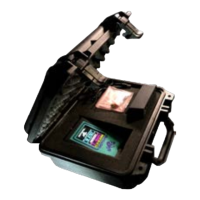
Once you have identied a Wi-Fi access point of interest, you can begin to locate it by choosing it
from the Wi-Fi MEASUREMENT list screen. That takes you to the WI-FI DIRECTION FINDING screen
seen here. This screen scans only the AP selected from the previous screen and delivers real time
and recently saved measurements allowing users to determine directionality of the AP scanned.
If you require a full Wi-Fi scan of all channels or Wi-Fi RF energy prole, use the BACK ARROW to
return to the MAIN MEASUREMENT screen.
In addition to Wi-Fi RSSI measurements in dBm, the WI-FI DIRECTION FINDING screen also dis-
plays the MAC address, Wi-Fi channel number and SSID of the access point.
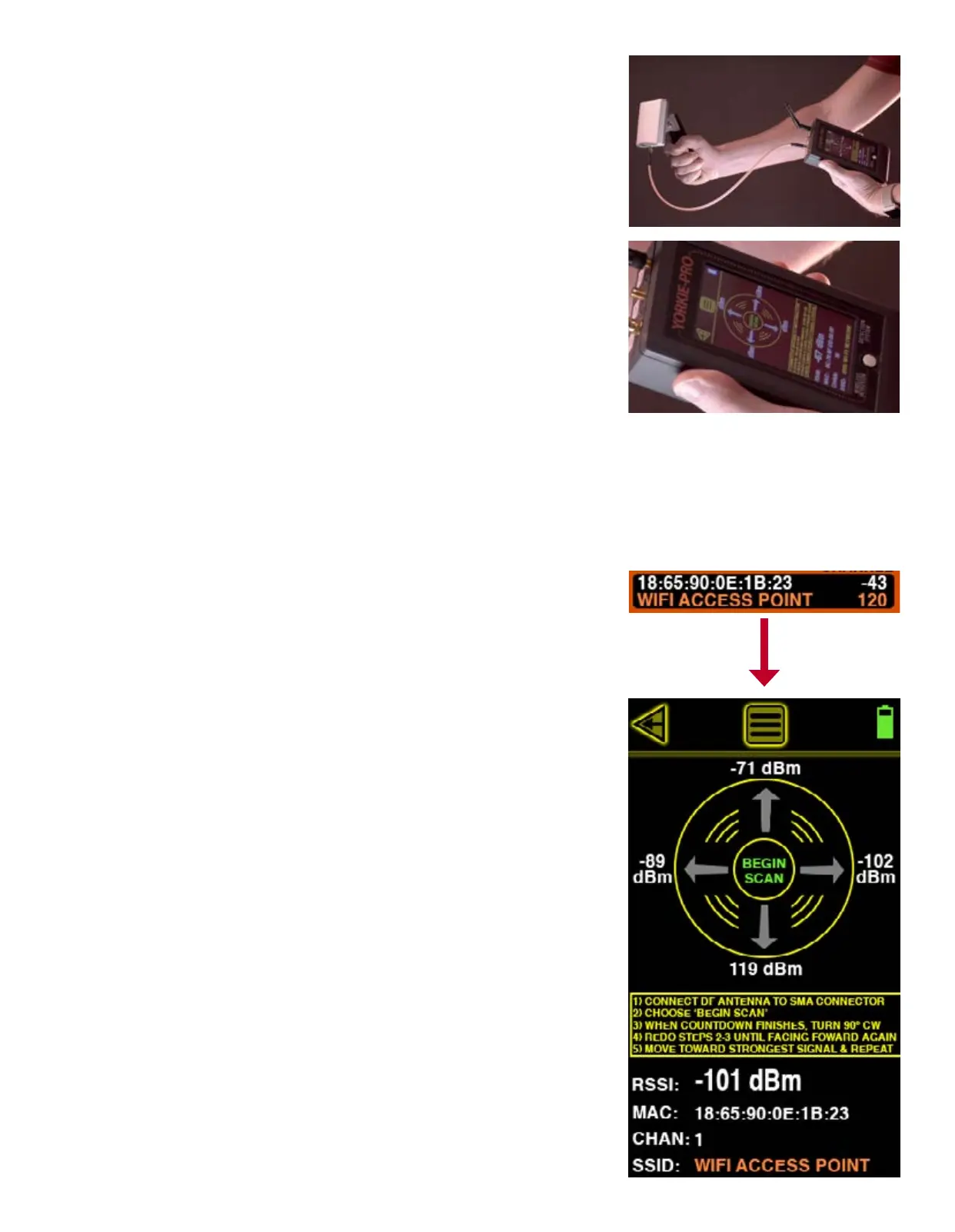
Replace the omni-directional antenna with the large, 2.4/5.8 GHz DF antenna by connecting to
the SMA connector on the left side atop the Yorkie-Pro unit. BEGIN SCAN will continue to blink
until you touch it. The Yorkie-Pro will now begin scanning. Point the direction nding antenna
away from the unit and yourself and keep it parallel to the ground. After a few seconds of scan-
ning, a number will appear atop the circle. Now you can turn 90 degrees and repeat the same
procedure until you are facing back in the original direction you started scanning.
Now that you have 4 different measurements (one for each direction) showing, you can deter-
mine the general direction of the access point you are trying to locate. For instance, the screen
shown here to the right indicates that the access point is most likely located between the two
highest measurements (between -89 dBm and -71 dBm) which means your new heading would
be somewhere between 10 and 11 o’clock or northwest (assuming you began your rst measure-
ment facing north). RF reections and Wi-Fi network interference can sometimes change results
mid-scan so you can choose to repeat all of the same steps again to doublecheck your results or
you can move in the direction that this screen has indicated. It is recommended that you do not
walk much further than 25-50 feet at rst because once you get close to the access point, the
measurements tend to look similar to one another due to the overall sensitivity of the direction
nding antenna. Effective direction nding is best accomplished through patience and small
incremental steps. You might consider practicing on known access points before attempting to
locate an unknown AP.


 To Next Page