EFL Operator Guide
Installation
Part No. MAN/EN5103-0076 Page 13 of 34 Revision A (Jan 2014)
The rotational angle shown above runs in the same direction as the bottom edge of the
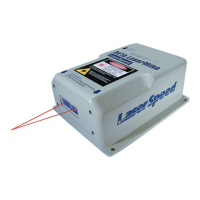
LaserSpeed gauge. The gauge must be aligned so the fiber optic cable or buffer tube
runs parallel to the gauge.
The tilt angle shown as angle B and C should be as close to 90° as possible. The
rotational angle and the tilt angle cause a cosine error as shown in the table above.
These two errors are additive and always result in the gauge measuring too short
lengths.
Positioning the LaserSpeed Gauges on the Buffering Line
The EFL system provides the length ratio between the fiber optic cable and the buffer
tube. Therefore, the EFL system must measure both the fiber optic cable and the
buffer tube simultaneously. One LaserSpeed gauge is installed on the fiber optic cable
and one gauge is installed on the buffer tube. A typical installation is shown in the
figure below.
Note: The EFL system measures the differential length of the material passing
between the two gauges. The measured EFL will vary depending upon where the
gauges are positioned on the extrusion line. This variation is dependent upon the
location of the fiber-buffer coupling location, the cure profile of the buffer, the buffer
material being used, and the buffer tension profile. The online EFL ratio can even go
negative under situations where the EFL ratio is low and there is a lot of stretch In the
buffer tube. It is up to user of this equipment to find the optimal location to mount the
gauges. The on-line EFL measurement must be correlated to the off-line
measurement. The correlation parameter is influenced by the positioning of the
gauges and the properties of the buffer material.



 To Next Page