13
Operation
Pre-Operation
Before operation, always perform the following safety checks
to ensure your safety and to maintain the integrity of your unit.
DANGER
Read the General Safety Manual before attempting to
operate this unit. Be sure all operators that will use this
equipment have read and understand the safety information
pertained to the operation of this unit.
CAUTION
Read theoperator's manual. Be sure all operators of this
equipment have read and understand the unit's features,
controls, and operation techniques.
CAUTION
Verify thespark plug wire is connected from the engine to
the unit.
CAUTION
Check engine oil and gasoline levels, and refill or refuel if
necessary.
DANGER
Evaluate the area to be operated. Note all obstacles, holes,
retaining walls, or other features that may impede operation.
Remove all objects from the area of operation that cannot
be vacuumed such as rocks, branches, garden hoses,
children's toys, lawn ornaments, etc.
Operation
1. Check the engine oil and fuel level. Fill if necessary.
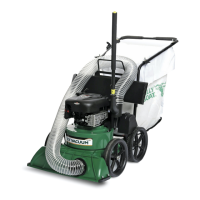
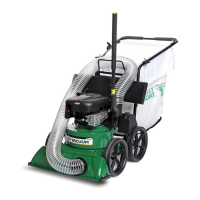
2. Check and adjust the vacuum nozzle height for the
present job. Use the nozzle height adjustment knob to
raise or lower the nozzle height. Adjust the nozzle height
so that the nozzle is close to the debris, but airflow is not
blocked.
3. Check the debris bag and fittings. Be sure the debris bag
is closed and the quick disconnect scoop is secured to
the housing. Tighten the ratchet strap, if necessary.
4. Start the engine. Pull back rapidly on the pull starter
handle to avoid kickback.
5. Adjust the throttle. Push the throttle control completely
forward for reach top engine speed.
6. Push or drive the unit forward in the operating area to
begin vacuuming debris. Self-propelled units: Firmly hold
the bail against the upper handlebar to activate the self-
propelled drive system. To deactivate the system, release
the bail.
7. Vacuum debris, taking care to avoid debris that the
impeller cannot process. Adjust the nozzle height as
necessary during operation. Continue vacuuming debris
until the debris bag is full.
Note:TKV units are equipped with an On-Board Chipper.
Feed branches into the chipper to process into wood chips.
Read the On-Board 2" Chippersectionto learn more about
how to safely use this feature.
8. Stop the unit (release the bail for self-propelled units).
Pull back the throttle control completely to shut off the
engine.
9. Remove the debris bag and empty the contents into
an appropriate container. Replace the debris bag and
continue operation until the work to be done is complete.
Stop and empty the bag when needed to avoid clogs.
10. When vacuuming is complete, stop the engine, wait for
the impeller to come to a complete stop, and wait for the
engine to cool before performing maintenance. Store the
unit safely, away from outdoor elements.
Vacuuming Tips
Use the following tips to vacuum safely and efficiently:
• Always observe the operating area and remove large
debris that cannot be vacuumed. Pick up any foreign
objects that could be damaged or cause damage to the
unit such as large rocks, children's toys, lawn ornaments,
etc.
• Frequently check and empty the debris bag during
operation. This will prevent overloading the machine.
• To vacuum in dusty conditions:
• Run the machine at low throttle. Consider operating
at idle to quarter throttle.
• Machine or pressure-wash the debris bag. Dust can
settle into the bag, causing poor performance. Clean
the bag thoroughly and be sure the bag is completely
dry before operation.
• Use the optional felt bag (P/N 840194). The felt bag
is designed to be used in dusty conditions.
• Consider purchasing a spare debris bag to reduce down
time while dirty bags are cleaned.
DebrisTips
Compost
Vacuumed leaves, grass, and other organic material from
your yard can be emptied into a pile or composter. As the
organic debris decays, this enriched material can be later
used as fertilizer in gardens and flower beds. Be sure to
separate trash from organic matter before operation if you
intend to compost vacuumed debris. Never put paper or
plastic debris in the compost pile.
Mulch
Wood chips made from branches in your yard can make
excellent mulch. A thick blanket of wood chips around plants
and flowers to keeps weeds out and moisture in. Always allow
green chips to dry out completely before spreading around




 To Next Page