
 Need help?
Do you have a question about the Binatone Speakeasy 6 and is the answer not in the manual?
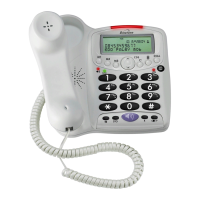
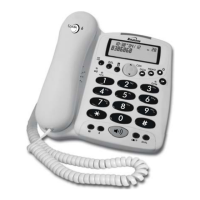
Identifies and describes the main buttons, lights, and controls on the telephone base unit and handset.
Explains the meaning of various icons displayed on the telephone's LCD screen for different functions and statuses.
Provides guidance on selecting a suitable location for the telephone base unit, considering power and phone line access, and avoiding hazards.
Details the step-by-step process for connecting the handset, telephone line, and power supply to the base unit.
Instructions for attaching the stand to the phone for desk placement, including removal steps.
Instructions for attaching the stand to the phone for wall mounting, including fixing centers and hook arrangement.
Guides the user through selecting the display language for the telephone interface from available options.
Details the process for setting the current time and date on the telephone for accurate record keeping.
Explains how to adjust the flash time setting, which is used for PBX or specific service compatibility.
Guides the user in adjusting the contrast level of the LCD display for better readability.
Allows setting the maximum recording duration for answering machine messages and memos.
Configures the number of rings before the answering machine answers incoming calls, including Toll Saver option.
Explains how to set or change the three-digit code required to access answering machine features remotely.
Describes how to adjust the ringer volume using the switch located on the back of the base unit.
Details the procedure for making calls using either the handset or the speakerphone, including pre-dialing.
Explains how to answer an incoming call by lifting the handset or using the speakerphone button.
Instructs on adjusting the speakerphone volume level using the dedicated switch on the base unit.
Describes how to terminate a call by replacing the handset or pressing the speakerphone button.
Explains how to switch between using the handset and the speakerphone during a conversation.
Details how to use the mute function during a call to prevent the other party from hearing you.
Explains how to redial the last number called using the dedicated button.
Guides the user on how to access and view the history of the last 10 outgoing calls.
Details how to redial numbers directly from the stored outgoing call records.
Explains the procedure for removing individual call records from the outgoing call history.
Instructions on how to save numbers from outgoing call records into the phone's memory.
Describes how to access and browse through the stored contacts in the phonebook.
Guides the user through adding new contacts, including inputting numbers and names using the keypad.
Explains how to initiate calls directly from the stored contacts in the phonebook.
Details the steps for modifying existing contact information (number or name) in the phonebook.
Emphasizes the need for a subscription to the Caller Display service from the telephone company.
Describes the information provided by Caller Display, such as caller number, date, time, and name.
Explains special network messages displayed for withheld or unavailable caller numbers.
Explains storage of calls and how to navigate the incoming call list, including NEW CALL indicator.
Explains how to redial a number directly from the displayed incoming call record.
Instructions for saving incoming call details from the Caller Display list into the phone's memory.
Details the procedure for removing individual records from the incoming call history.
Explains the purpose of Outgoing Messages (OGMs) and the two default messages available.
Guides on how to play the currently active outgoing announcement message.
Provides step-by-step instructions for recording a custom outgoing message (OGM1).
Provides step-by-step instructions for recording a custom outgoing message (OGM2).
Instructions for switching the answering machine system on and off using the power button.
Guides on how to select between OGM1 (recordable) and OGM2 (non-recordable) announcements.
Details how to record a personal memo message directly into the answering machine.
Details how to play messages, pause playback, restart, and handle cases with no messages.
Explains controls for replaying, rewinding, and skipping through recorded messages.
Instructions for stopping message playback and adjusting the speaker volume during playback.
Explains how to interrupt the answering machine recording to speak to the caller.
Guides the user on how to delete a single incoming message during playback.
Explains how to erase all recorded messages from the answering machine memory.
Details how to revert from custom OGMs back to the original pre-recorded default messages.
Guides on how to view the currently set three-digit remote access code for security.
Explains how to dial in and access answering machine messages from outside the home.
Lists the keypad commands for controlling answering machine functions remotely.
Details how to remotely activate the answering machine if it was previously switched off.
Provides essential safety precautions regarding water, thunderstorms, and handling the electrical components.
Reiterates best practices for positioning the base unit, considering power, line, and environmental factors.
Offers advice on cleaning the unit safely and protecting it from environmental damage.
Lists fundamental checks to perform before diagnosing specific issues with the telephone.
Addresses common problems like inability to make/answer calls, no ring, or no dial tone.
Explains that Caller Display functionality requires a subscription from the telephone company.
Addresses problems with message recording, remote operation, and PBX compatibility for dialing.
Troubleshoots issues related to redialing and memory dialing when connected to a Private Branch Exchange (PBX).
Explains how to manage PBX systems requiring a second dial tone before dialing.
Provides steps to isolate faults by testing line connections and other connected instruments.
Details the 12-month guarantee, its exclusions, and the requirement to keep the sales receipt.
Details the steps for returning the product for repair or replacement while it is under warranty.
Provides instructions for obtaining repair services and quotations after the warranty period has ended.
Provides technical details including operating temperatures, power requirements, and standards compliance.
States compliance with EC directives and relevant harmonized safety and EMC standards.
Explains how the SpeakEasy 6 can be connected to different types of telephone lines and PBXs.
Discusses REN values and the limit for instruments connected to a telephone line to ensure proper ringing.
 General
| Type | Analog telephone |
|---|---|
| Answering machine | Yes |
| Mounting type | Desk |
| Product color | Silver |
| Phonebook capacity | 120 entries |
| Backlight color | Green |
| Wireless connection | No |
| Storage temperature (T-T) | -20 - 60 °C |
| Operating temperature (T-T) | 0 - 40 °C |
| Power requirements | 230V, 50Hz |



 To Next Page