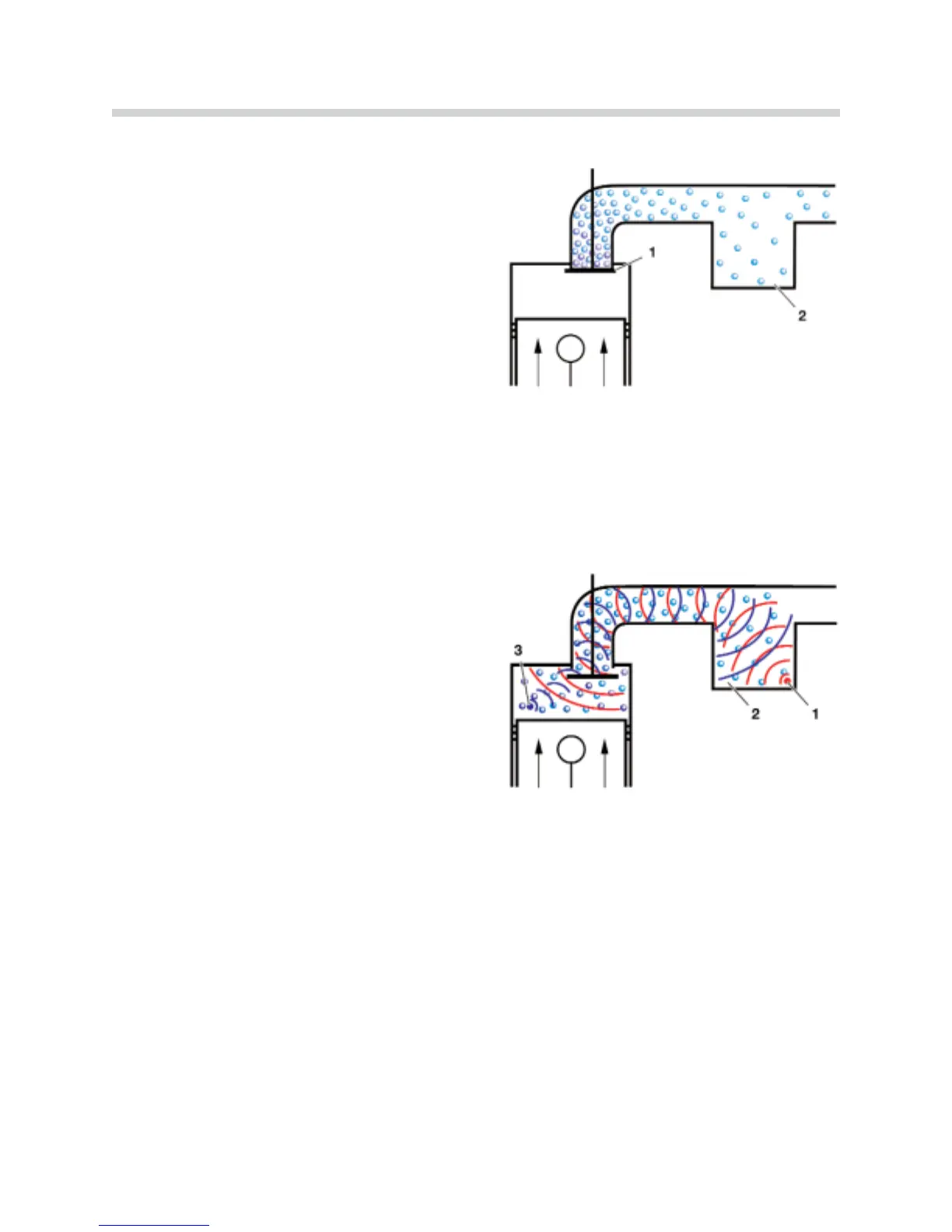
This is only possible if the intake valve is closed
and the mass inertia causes the intake air to
flow in front of the closed intake valve. The air is
compressed, the pressure and the air flow
increase.
IInnttaakkee aaiirr fflloowwss iinn ffrroonntt ooff tthhee cclloosseedd iinnttaakkee
vvaallvvee..
1. Closed intake valve
2. Intake manifold
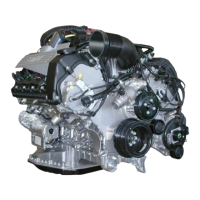
As soon as the intake valve is opened, the pres-
surized intake air flows into the cylinder,
expands and draws the air molecules which fol-
low into the cylinder. The suction waves form in
the intake pipe (moving at sonic speed) in the
opposite direction to the intake air.
These suction waves are reflected in the intake
manifold and create pressure waves which then
move once more at sonic speed in the direction
of the intake valve.
MMoovveemmeenntt ooff tthhee iinnttaakkee aaiirr wwiitthh tthhee iinnttaakkee vvaallvvee
ooppeenn..
1. Pressure waves
2. Air manifold
3. Suction waves
The intake pipe is at the optimum length when the pressure waves are at the intake valve
shortly before it is closed. The increase in pressure in front of the intake valve results in
increased air flow to the cylinders once more. This process is described as recharge effect.
The opening angle of the intake valve remains unchanged as the engine speed increases.
The opening time, however, is reduced proportionately (with conventional, non-Valvetronic
engines).
Since the suction waves and pressure waves expand at sonic speed, the suction path
length must be adapted depending on the engine speed to ensure that the tip of the pres-
sure wave reaches the intake valve before it is closed.
9
N62 Engine
42-02-07
42-02-08



 To Next Page