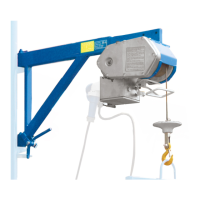
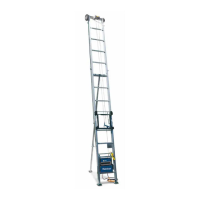
5 Operation of LMX / LHX
The installation lift must only be used on even surfaces, all locks at the castors must be
engaged and never overloaded.
Installation lifts must not be wheeled around when loaded. The material lifts can be used within
enclosed spaces. Under the conditions listed in point 6 “Monitoring of safety equipment” in
these operating instructions, the material lifts listed can also be used outside closed spaces
(see page 14).
LMX:
The load is lifted by turning the crank handle clockwise. The load is automatically held if the
crank handle is released. To lower the load, the crank handle must be turned anti-clockwise.
The crank handle is prevented from winding back by means of an integrated automatic brake.
Approx. 20 m of unloaded cable can be spooled on the winch drum. Only a length of cable still
enabling the winch drum flange to project at least 1.5 times the cable diameter can be spooled.
This avoids overloading the winch and the cable running off at the side of the drum. It is
important to ensure that the wire rope is correctly wound onto the winding drum. When driving
down while loaded, at least 2 winds of the cable must remain on the drum.
Zinc coated according to DIN 3060, Section 20 + 22
VBG 14 UVV (Accident Prevention Regulations)
LHX:
After the power supply required for the unit has been established, switch the unit on via the
motor protection circuit breaker. The circuit breaker serves at the same time as emergency
shut-off for the unit. The hydraulic winch is operated via a manual control valve.
• Manual lever up = load upwards
• Manual lever down = load downwards
After releasing the manual lever, it automatically goes into the middle position and the hydraulic
winch is shut down. The raised load is then kept in the respective position by means of a non-
return valve and hydraulically operated brakes.
An overloading of the hydraulic winch due to overload is prevented by a pressure relief valve.


 To Next Page