Section 3 Operation
3-22
3-93. End-Of-String (EOS) Control. The instrument
provides several end-of-string options to accommodate a
wide variety of controllers. The instrument always ter-
minates on EOI (end-or-identify) true and always sends
EOI true with the last character of every string. In addition,
CR, LF, or CRLF may be used. The use of CR and LF is
selected by option switch A4S1-1 and 2 and special
functions 1 through 4. Detection of EOI is not affected by
A4S1 switch settings.
3-94. Using “Service Request” (SRQ). The instrument
may be configured to set SRQ true when it is in the
remote mode and an error occurs. This is enabled y
setting the option switch A4S1-6 to the open position. The
bus controller must be programmed to respond to SRQ
true. In the usual case, the controller then executes a
serial poll to determine which device caused SRQ to be
true. If the instrument is the requesting device, it will
respond to the serial poll with a single byte which
expresses the error code number in excess sixty-four.
The serial poll will clear the SRQ line automatically. In
small systems only one instrument may be capable of
using SRQ. In this situation there is no need to execute a
serial poll since the identity of the requesting device is
known. The error code may be obtained directly from the
talk status (TS) mode. The SRQ line can then be cleared
by sending the clear (CL) command.
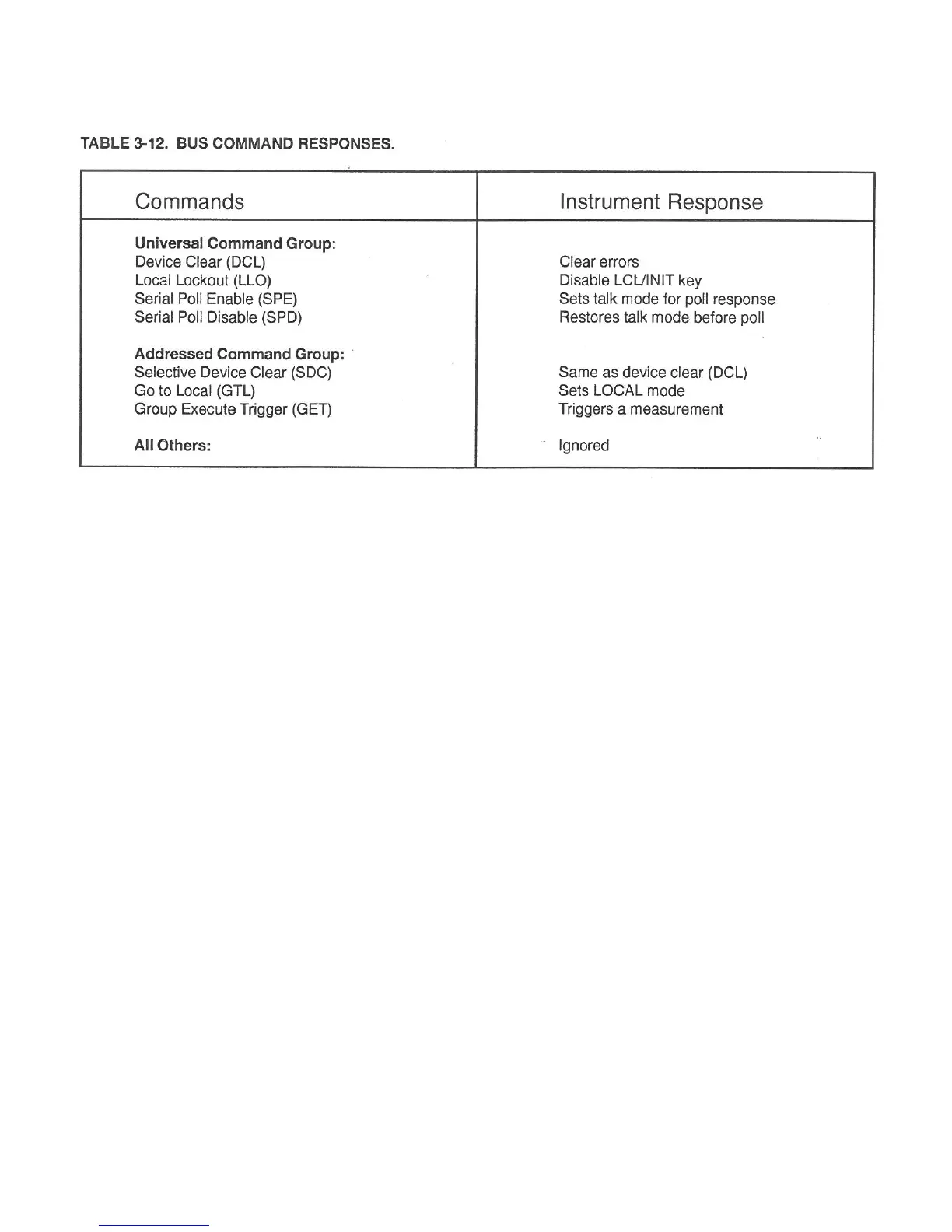
3-95. Bus Command Responses. IEEE-488 bus com-
mands are sent by the controller to all devices on the bus
(Universal Command Group) or to addressed devices
only (Addressed Command Group). The response of the
instrument is listed in Table 3-12.
3-96. Program Function Mnemonics. Each front
panel key is assigned a program mnemonic.
Programming the mnemonic, followed by unit values, if
appropriate, is analogous to manual front-panel
operation. In addition, other program mnemonics are
used for functions that are applicable only in remote
operation. Table 3-10 lists all the program function
mnemonics.
3-97. Number Formatting. Number formatting rules are
as follows:
a. Fixed or floating formats are accepted.
b. The optional + or - sign may precede the mantissa
and/or the exponent.
c. The optional radix point may appear at any po-
sition within the mantissa. A radix point in the exponent
is ignored.
d. The optional “E” for exponent may be upper or
lower case.
e. ASCII characters having hexadecimal values of 0
to 23 and 26 to 2B are ignored.
3-98. Data String Format. Data string formats are as
follows:
a. The programming sequence is in natural order,
that is, a function mnemonic is sent first followed by the
argument, if appropriate.


 To Next Page