B-1
RADIOLOGY CHECKLIST FOR THE IMAGEREADY PACING SYSTEM
APPENDIX B
This appendix is provided for convenience. Refer to the remainder of this Technical Guide for the
full list of Warnings and Precautions and complete instructions for using the ImageReady Pacing
System.
Conditions of Use – Radiology Scanning Procedure
The following Conditions of Use must be met in order for
a patient with an ImageReady Pacing System to undergo
an MRI scan.
MRI magnet strength of 1.5 T or 3 T (see "ImageReady
Pacing System Components for 1.5 T and 3 T" on page
C-1)
• 1.5 T
• Radio frequency (RF) field of approximately 64
MHz
• Spatial gradient no greater than 50 T/m (5,000
G/cm)
• 3 T
• RF field of approximately 128 MHz
• Spatial gradient no greater than 50 T/m (5,000
G/cm)
Horizontal,
1
H proton, closed bore scanners only
Specific Absorption Rate (SAR) limits:
• For FINELINE II leads only or for one FINELINE II
lead and one INGEVITY MRI lead, SAR limits for
Normal Operating Mode
a
must be observed for the
entire active scan session as follows:
• Whole body averaged, ≤ 2.0 watts/kilogram (W/
kg)
• Head, ≤ 3.2 W/kg
• For INGEVITY MRI leads only, SAR limits for Normal
Operating Mode
a
or for First Level Controlled
Operating Mode
b
must be observed for the entire
active scan session as follows:
• Whole body averaged, ≤ 4.0 W/kg
• Head, ≤ 3.2 W/kg
Gradient Field limits: Maximum specified gradient slew
rate ≤ 200 T/m/s per axis
No local transmit-only coils or local transmit/receive
coils placed directly over the pacing system; the use of
receive-only coils is not restricted
Patient in supine or prone position only
The patient must be monitored during the MRI scan by
pulse oximetry and/or electrocardiography (ECG)
Pre-scan
1. Ensure Cardiology has cleared the patient for scanning
eligibility based on the Cardiology MRI Conditions of Use
(see "Cardiology Checklist for the ImageReady Pacing
System" on page A-1) and has provided the model
numbers of the pulse generator and lead(s) implanted in
the patient.
2. Ensure patient meets all Radiology Conditions of Use
for MRI scanning (see left column).
3. Refer to the MRI Protection Settings Report to confirm
that the patient’s device is in MRI Protection Mode. If the
Time-out feature is used, the report includes the exact
time and date when MRI Protection Mode will expire.
Verify that adequate time remains to complete the
scan.
During Scan
4. Ensure the patient is continuously monitored by pulse
oximetry and electrocardiography (ECG), with backup
therapy available (external rescue), while the device is in
MRI Protection Mode.
After Scan
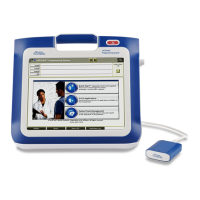
5. Manually exit MRI Protection Mode using the PRM to
return the pulse generator to pre-MRI operation. Perform
follow-up testing of the implanted system.
a. As defined in IEC 60601-2-33, 201.3.224, 3rd Edition.
b. As defined in IEC 60601-2-33, 201.3.208, 3rd Edition.
WARNING: Unless all of the MRI Conditions of Use are met, MRI scanning of the patient does
not meet MR Conditional requirements for the implanted system, and significant harm to or death
of the patient and/or damage to the implanted system may result.
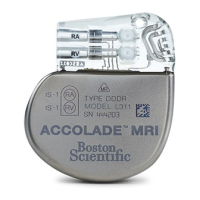
WARNING: Only the combination of INGEVITY MRI lead(s) with an ESSENTIO MRI,
PROPONENT MRI, or ACCOLADE MRI pulse generator is valid to use with either 1.5 T or 3 T



 To Next Page