Introduction to MR Conditional Pacing
MRI Protection Mode
1-11
Table 1–5. Radiology Conditions (continued)
Condition for Scanning (Rationale) Actions If Condition is Not Met
Potential Clinical
Consequences
Risk is Highest for
There are no restrictions for positioning
the pacing system within the integrated
body coil of the MRI scanner. System
response to local transmit-only or
transmit/receive coils placed directly over
the pacing system has not been
evaluated.
heating at the lead/
tissue interface
• Erratic pulse generator
behavior
• Inappropriate pacing,
inhibition of pacing, or
irregular intermittent
capture or pacing,
possibly resulting in
pre-syncope or syncope
• Pocket discomfort due
to pulse generator
heating
• Patients with high
capture thresholds
6. The patient must be in a supine or
prone position during the scan.
An ImageReady Pacing System mitigates
hazards associated with a patient position
of supine or prone. System response to
other patient positions has not been
evaluated.
• Ensure patient is in the
correct position during
scan.
• Arrhythmia induction
• Clinically significant
pacing threshold
changes and sensing
changes as a result of
heating at the lead/
tissue interface
• Inappropriate pacing,
inhibition of pacing, or
irregular intermittent
capture or pacing,
possibly resulting in
pre-syncope or syncope
• Physical movement of
pulse generator and/or
leads
• Pocket discomfort due
to pulse generator
heating
• Pacing-dependent
patients
• Patients prone to
sustained arrhythmias
• Patients with high
capture thresholds
7. The patient must be monitored during
the MRI scan by pulse oximetry and/or
electrocardiography (ECG).
• Ensure patient is being
monitored during scan.
• Lack of patient
monitoring could result
in failure to detect
potentially dangerous
changes in the patient’s
cardiac or
hemodynamic function.
• All patients
MRI PROTECTION MODE
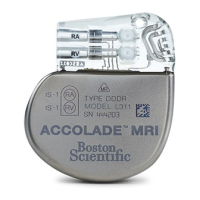
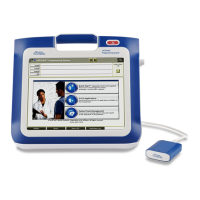
In preparation for an MRI scan, the pulse generator must be programmed into MRI Protection
Mode using the programmer. MRI Protection Mode modifies certain pulse generator functions in
order to mitigate risks associated with exposing the ImageReady MR Conditional System to the
MRI environment. For a list of features and functions that are suspended in MRI Protection
Mode, see "MRI Protection Mode General Information" on page 2-2.
MRI BASIC CONCEPTS
MRI is a diagnostic tool that uses three types of magnetic and electromagnetic fields to image
soft tissue in the body:
• A static magnetic field generated by a superconducting electromagnet coil, 1.5 T or 3 T in
strength.
• Gradient magnetic fields of much lower intensity, but with high rates of change over time.
Three sets of gradient coils are used to create the gradient fields.



 To Next Page