EN
INTRODUCTION
This manual describes the operation of the GSM series GSM telephone GSM telephone diallers.
The GSM series is a family of DSM GSM telephone GSM telephone diallers that makes it possible to send alarms via SMS
or vocally.
Up to 5 voice messages can be recorded for up to a maximum of 20 telephone numbers. The alarm inputs can be set as
NA or NC and can be activated with positive/negative present or missing.
Each input is able to sent a voice or SMS message or both.
If an input is activated, the device will call all telephone numbers assigned to that input for a number of times that is equal
to the number of programmed calls.
The GSM GSM telephone GSM telephone dialler series consists of 4 models that differ by number of users, number of
inputs, voice message customisation and other special functions:
The model GSM10 is a GSM telephone GSM telephone dialler with 2 inputs, 4 outputs, 3 customisable messages and 20
users;
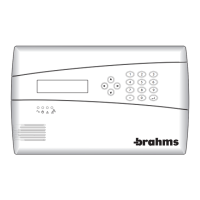
The model GSM11 is a GSM telephone GSM telephone dialler with keypad and display with 2 inputs, 4 outputs, 3 customis-
able messages and 20 users;
The model GSM20 is a GSM telephone GSM telephone dialler with 4 inputs, 4 outputs, 5 customisable address message
and 20 users;
The model GSM21 is a GSM telephone GSM telephone dialler with keypad and display, which includes evolved alarm unit
functions, with 4 inputs, 4 outputs, 5 customisable address messages, 20 users and 50 Barrier users.
Basic Characteristics
• Integrated GSM module,
• 2/4 alarm inputs (customisable NA – NC),
• 4 outputs that can also be controlled remotely (Via SMS – Clip - DTMF tones),
• 4 voice alarm messages + 1 address message,
• 1 SMS for each alarm input (max. 20 characters for each SMS),
• 20 users for alarm notifications,
• Programmable calling sequence,
• Remote listening function,
• Tele-emergency function,
• 4 control LEDs,
• Integrated microphone and speaker,
• CEI 79-2 compliant.
Use and Applications
GSM provides different information about the GSM signal status and can transmit different types of alarm messages.
Its main applications include:
- Equipment failure signal (for example, electromechanical devices).
- Remote equipment control (for example, gates or boilers).
- Alarm signals for buildings, vehicles, caravans, campers or boats (for example off shore or moored craft).
- Remote listening (for example, room or elevator monitoring).
- Control of various sensors (for example, temperature or alarm sensors).
- Emergency condition notification (burglary or emergency alarms).
40
Installer's Manual-Description of the card
40


 To Next Page