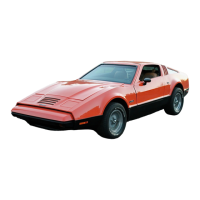
Bricklin EV-1 Owner's Manual
The power to offer performance exceeding the original vehicle required that the controller be of a
liquid cooled design.
The WarP-Drive Industrial is the only controller on the market that could meet all of these
requirements as well as providing additional flexibility which includes the ability to be field upgraded to
higher power levels through a firmware download over the Internet.
Some of the additional features include:
• 160/260/360 Volt DC input capability (field upgradeable via software download)
• 1000/1200/1400 Amps available (field upgradeable via software download)
• 550 Amps continuous rating with 1.5 GPM liquid cooling
• Dimensions: 22x7x4 in.
• Weight: 23 lbs .
• Built-in precharging
• Dual CANbus ports
• Film capacitors in the power section
• Completely sealed device.
• Battery connections on one end, motor connections on the other for added safety
• 1/2” OD copper tubing for liquid cooling
• dual current sensors for added safety
• completely isolated throttle channels for added safety
Range
We can obviously produce more than adequate horse-power and torque, but one of the concerns
people who are considering an electric vehicle have is RANGE! In the industry we refer to this as
“range anxiety”. The range of the vehicle can no longer be calculated as miles per gallon, rather a
more common calculation is kW/mile. There are numerous factors that will determine the range.
Some of the factors that must be considered are, coefficient of drag, frontal area, rolling resistance,
speed on level terrain, speed on grade, the percent grade, gear ratios, and tire diameter, drive-train
efficiencies, temperature (which affects viscosity of fluids), and other factors. The rate of acceleration
also plays a significant roll in range, as does the maximum speed.
For the Bricklin EV-1 we are targeting a conservative range of 75 miles at 50 MPH. The range would
be increased if traveling on level terrain without any stops at 45 MPH. Likewise, it will be significantly
decreased if traveling at 75 MPH on hilly terrain, or if making very quick starts.
The energy needed to accelerate mass over time is quite significant. Therefor, rapid 0 -60 MPH
acceleration, though possible, will have a significant impact on the range. This holds true with ICE
vehicles as well, though the abundance of fuel stations makes it fairly convenient to refuel.
DRAFT Page 11 of 31 DRAFT



 To Next Page