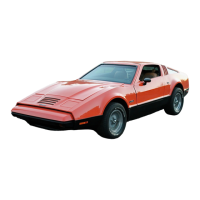
Bricklin EV-1 Owner's Manual
The features of the PulsaR unit include:
• Works with up to 370 Volt DC battery pack
• 500 Amp controller (optional, and not included in the Bricklin EV-1)
• Up to 24 kW AC Charging
• Internal DC-DC converter with up to 53 Amps provided to high quality connector, voltage
adjustable from 12 to 15 Volts via trim pot
• DC fast charge up to 150 kW
• Liquid cooling with large ½ in. diameter tubes for low pressure drop
• Native J1772 compatibility
• All contactors built in
• Dimensions: 18.5 x 14.5 x 5.5 inches
• 34 lbs. total weight
• Built-in precharging
• CANbus
• Film capacitors in the power section
• Completely sealed device with cable glands for all power cable connections and high quality
waterproof connectors for all other wiring
• Intelligent PWM control for external motor blower
• Liquid cooling pump control output
• Provision for charging to/from external battery pack to/from traction pack
Transmission
As previously mentioned, the electric motors are extremely powerful and may be rotated in either a
clock-wise or counter-clockwise rotation. For this reason, many people believe a transmission is not
required. But, reverse rotation is not optimal for the WarP Motor design, so having a transmission
allows for easy reversing of the vehicle as well as other advantages.
Direct drive applications also introduce a safety risk. If there were a catastrophic failure in the
electrical system that caused the motors to see full battery pack power, there would be no way to stop
the vehicle. The motors would have no problem overpowering the brakes, and unless a fuse blew or
a safety switch was successfully thrown, there would be no way of stopping the motors.
A transmission allows for a manual disconnect in extraordinary situations. Although the motors have
the torque to get the vehicle moving, they will draw far more amperage for a longer period of time
without a transmission. As with ICE engines, the motors have a sweet-spot where they like to
operate. This is normally in the 2,000 - 4,000 RPM range. The rule-of-thumb for these electric
motors is: the electric motors are most efficient when run about 1,000 RPMs higher per gear than the
ICE engine.
DRAFT Page 13 of 31 DRAFT



 To Next Page