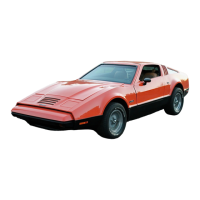
Bricklin EV-1 Owner's Manual
only use one of the phases – typically half the circuits on one phase and the other half on the other
phase. But an electrician can easily wire a NEMA 14-50 range/oven connector into your garage to
provide 240 Volt AC charging to your car. The charge for this varies based on how far the circuit box
is located from where the outlet is located, but is often available at $200 -$400 and no special code
provisions beyond this are necessary. A 60 AMP circuit breaker is more than adequate.
When connected to 240 Volt AC the Pulsar Power Distribution Unit and charger will initially charge the
~170 Volt DC battery pack at about 24.5 amperes. This will continue until the pack voltage reaches
~168 Volt DC. At that point, the current will begin to decrease. If you leave it charge unattended, you
can tell that it has completed when the current indication is less than a couple of amperes. The
charger itself is totally silent and so the meter is the only indication you will have that it is actually
charging.
If you completely deplete the 160 Ah in the pack, at 24 amperes it would reach full charge in about six
hours and 45 minutes.
If you use 120 Volt AC connections, this time could be doubled.
You can see that the vehicle charges faster from 240 Volt AC, and the actual charge time is totally
dependent on how many ampere-hours have been removed from the pack by driving the car. Thus,
taking advantage of charging when it presents itself is a good idea. We refer to this as “opportunity
charging”.
The vehicle uses a DC-DC converter that is an integral part of the PulsaR Power Distribution Unit to
convert the ~170 Volt DC pack voltage to 13.2 Volt DC to keep a 12 Volt DC battery at an optimum
state of charge in order to power the auxiliary equipment on the vehicle such as the radio, clock,
headlights, water pump, and instrumentation. Much like the 12 Volt DC battery in your ICE car, this is
“on” all the time. There may be some minor drain of the traction batteries all the time.
If you are going to store the vehicle unused for an extended period of more than a week or two, you
can shut off this DC-DC converter by setting the emergency disconnect switch to off. This may reset
all instrumentation in the car.
Most owners typically plug the vehicle in at night and allow it to charge overnight.
Once you have a 240 Volt AC charge port in your garage or driveway, the act of connecting the cable
to the charge port on the vehicle only takes a few seconds.
The unexpected result of all this is that your vehicle does have limited range. But each morning when
you go to get in it, it has a totally full tank. And you will quickly learn that you were actually spending a
LOT of time going to the gas station in your other cars and you never have to do so with the Bricklin
EV-1. It’s just full all of the time. And it is almost noticeable how easy it is to “refuel”.
Charging Costs
Because of the lack of mass production, electric vehicles can be expensive to produce using costly
low volume components, and we’ve used the very best components currently available. The LiFePo4
cells are really what has made electric vehicles finally viable and practical, but they are expensive.
As a result, economy is not the reason to purchase an electric vehicle. It is more a personal identity
DRAFT Page 23 of 31 DRAFT



 To Next Page