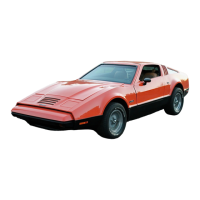
Bricklin EV-1 Owner's Manual
Introduction
How the Bricklin Was Chosen
I have been the owner of a 1975 Bricklin since 1976. When I initially purchased the vehicle it had
approximately 5,000 miles on the odometer. The Bricklin was my daily driver for a couple of years,
and then it began to sit for longer and longer periods of time. For many years it resided in my garage
doing nothing more than taking up much needed space.
At one point I decided to take the Bricklin to Michigan to have air-doors and a console installed. Upon
returning, it sat in the garage again. When I finally began to drive it, I found that it was not running
very well. I decided to have it brought back to life, in a more invigorated form. I had the engine
rebuilt, added a 4BBL Holley carburetor, aluminum high-rise manifold, headers, aluminum radiator,
and other miscellaneous items (i.e. new brakes, fluids, etc.). I also decided to change the original
color from “suntan” to another original color, “white”. I prepaid for all the work. After five years the
vehicle was returned by the shop that performed the above mentioned work. I learned a valuable
lesson about paying for the work performed in advance of the work actually being performed.
Though I had hoped the performance would be greatly improved, it turned out the work was very sub-
standard. After >$15,000 the vehicle barely ran without dying, and the paint job was seriously flawed.
I was quite disenchanted, and the vehicle went back to the garage space it had become accustomed
to. After 37 years the 1975 Bricklin still had less than 34,000 original miles.
Unlike the Bricklin, I continued to work, and to build a new company renown for powerful electric
motors commonly used in converting vehicles from gasoline burning internal combustion engines, to
pure electric motor power. Series wound, brushed DC Motors are capable of producing enormous
amounts of torque at stall speed. A single WarP 11 motor has a peak stall torque of 1,959 ft-lbs. - if
you could provide it with enough amperage (~3,951 Amps). The amount of torque developed is
based upon the Amperage squared (I²). Simply put, if you double the amperage you quadruple the
torque – at least until saturation occurs at which time the torque increase becomes linear. The
voltage supplied to the motors determines the RPMs the motor will spin at. This is a nearly linear
relationship. If you double the motors voltage, you will double the RPMs, and thus the HP (Horse
Power). Actually, it is slightly more than double since most losses are fixed. There are limits as to
how much voltage and amperage these motors can sustain, but they are quite robust.
Using early versions of these powerful electric motors a battery powered dragster was developed that
was capable of 60' times under one second (.986). Unfortunately, the lead-acid or PbA batteries of
the late 1990's were not capable of sustaining the power level needed to maintain that rate of
acceleration for more than a few seconds. Even so, the vehicle was capable of 10 second ¼ miles
nearing 130 MPH.
Batteries
Super-capacitor testing was performed in the dragster in conjunction with NASA Illinois and the NASA
Glenn Research Center. When the super capacitors were connected in parallel to the battery pack,
they became slaves of the batteries. This meant that they could not output any power exceeding
what the PbA batteries were capable of. But, the testing of the super capacitors did lead us to
another new battery technology generally referred to as Lithium chemistry based batteries.
DRAFT Page 5 of 31 DRAFT



 To Next Page