Bricklin EV-1 Owner's Manual
In the late 1990's lithium batteries developed a rather poor reputation for catching fire in laptop
computers. But, technology has marched forward, and today's Lithium-Iron-Phosphate cells, when
used in the proper manner, have shown that they are much more robust and safer than the batteries
of a decade before.
The LiFePO4 batteries provide enough power to triple the range of electric vehicles that were
powered by PbA batteries. Additionally, lithium batteries have an extremely long life, are not as
affected by hot or cold temperatures as PbA , are lighter than PbA, more powerful than PbA, display
no memory effect, and have high discharge and charge rates. The downside of the LiFePO4
batteries is that they cost approximately two to three times the cost of PbA batteries. Due to their
long life they are actually less expensive then using PbA when amortized over time.
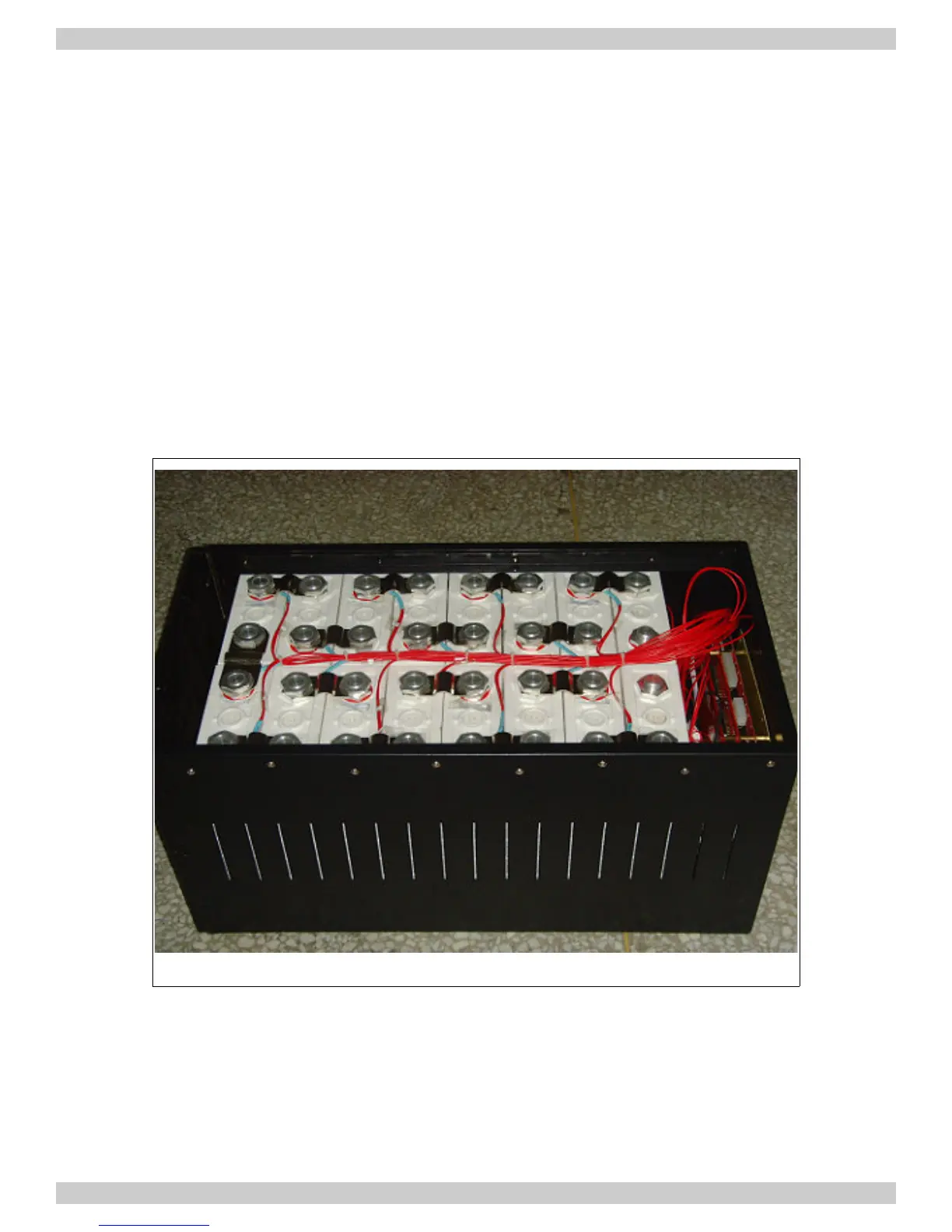
For the Bricklin EV-1, a quantity of 48, 3.65 Volt, LiFePO4 prismatic cells rated at 160 Amp hours
each were chosen. The original gas tank was removed and 18 of the cells were placed in a
replacement box located in the original gas tank position and arranged in a similar manner to those
shown in the Illustration below.
The rest of the cells (30) are arranged under the hood of the vehicle and above the electric motor. All
of the cells were connected in series to provide a fully charged pack voltage of 172.8 Volts (48 * 3.6).
The cells weigh 11.53 pounds (5.23 kg) each and are 6.65” W X 3.35” D X 9.72” H (169 X 85 X 247
mm).
The cells are rated at 3C which means they can output 3 times their Ampere-hours rating, or 480
DRAFT Page 6 of 31 DRAFT
Illustration 1: Example of 16, LiFePO4 prismatic cells with BMS



 To Next Page