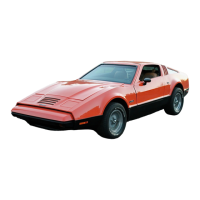
Bricklin EV-1 Owner's Manual
Power
The progress in power electronics and electric motor controls has advanced by leaps and bounds
over the past decade. Pulse Width Modulated (PWM) high power DC motor controllers that are
capable of >3,500 Amps at >400 Volts (~1,400 kW) are readily available. And, unlike the controllers
of the 1980's and 1990's, the new generation of high power motor controllers are safe and smooth in
operation.
What does this 1,400 kW really equate to? Well, the formulas work like this:
Watts = (Volts * Amps)
HPe
1
= (Watts / 746)
The result would be:
Watts = (400 * 3500)
HPe = (1,400,000 / 746) or 1,877 HPe
But, realistically, you need to account for the losses (efficiency) of the electrical system. It would be
easier, and closer to reality to say:
HPe = (1,400,000 / 1000) or 1,400 HPe (after losses)
Unlike Internal Combustion Engine (ICE) vehicles that produce torque and HP that is usually nearly
equivalent to one another (~1 HP to ~1 ft lb), it should be noted that the type of electric motor being
used in the Bricklin EV-1 produces almost 2 ft. lbs of torque per HP produced.
As a side note, mechanical horsepower is calculated as:
HPm
2
= ( ( Ft. Lbs * RPM ) / 5252 )
Motor Selection
Even though the NetGain Motors, Inc. WarP Motors are recognized as the most robust production
motors for EV applications, a single motor cannot handle the potential amount of input power from
these extraordinarily powerful motor controllers for more than a few milliseconds (not to mention the
impact on the rest of the drive-line).
To avoid destroying the motors (and the drive-line), it is quite common to utilize:
• lower power settings on the motor controller,
• lower power motor controllers,
• larger and more powerful motors,
• multiple motors to share the power,
• some combination of the above options.
1 HPe = Horsepower electrical
2 HPm = Horsepower mechanical
DRAFT Page 8 of 31 DRAFT



 To Next Page