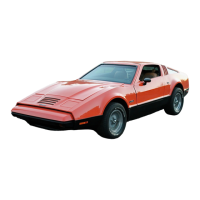
Bricklin EV-1 Owner's Manual
In actually using the vehicle you will quickly learn neither is really very important to most drivers.
The quick answer is 75 miles, and 7 hours. Both are actually extremely variable. The 75 miles is quite
variable depending on how you drive the car. We have driven the vehicle in testing over 100 miles in
urban stop and go while still within the 162 Ah limit. Similarly, driving 90 miles per hour on the freeway
will not only deplete the pack within 50 miles, but can result in a speeding ticket.
The amount of charge time depends on how far you have driven the vehicle and how much power
you are capable of dumping back into the battery pack, and what the battery pack can handle coming
in.
In actual practice, American drivers AVERAGE 39.4 miles per day and the MEDIAN daily drive is 26
miles, meaning half the licensed drivers average 26 miles per day or less.
The LiFePo4 cells are truly remarkable devices and account for much of the expense of the electric
vehicle. They exhibit very few of the churlish characteristics of lead acid, nickel cadmium, or nickel
metal hydride cells. For example, there is NO advantage to fully discharging these cells - ever. There
is no memory, and there is no need to ever fully charge them. They do not sulfate, they need not be
“balanced”, they do not take water, and they really behave quite remarkably well in both hot and cold
temperatures. You may note about a 10 -15% decrease in range in temperatures below freezing.
But, they do NOT like to be overcharged!
And, they do NOT like to be over-
discharged! By limiting your driving to 75
miles on a charge, these cells should last for
>2000 charging cycles. By way of
comparison, lead acid cells of the very best
industrial design are typically good for 350
cycles (from fully charged, to fully
discharged, to fully recharged).
If you limit your driving to 50 miles between
charges, you can FURTHER extend the life
of these cells by 50% to 3000 cycles.
What this means in actual practice is that
you can charge when and where you like, as
often as you like, without regards to cell
chemistry quirks. And a lesser cycle doesn’t really count as a full cycle.
For example, let’s say you drive 12 miles on errands in the morning and return home for lunch. Go
ahead and plug it in. That you are not going to do a “full charge” means nothing to the LiFePo4 cells.
A 30 -minute recharge is fine. Then return to errands or whatever after lunch, when you return home,
plug it in again. You are not “using up cycles” in this way, you are actually extending the life of the
cells dramatically.
To prevent overcharging, we have provided a charger that charges at a constant current level until
the pack reaches a voltage of ~168. At that point, it switches to constant voltage mode and holds that
DRAFT Page 21 of 31 DRAFT
Illustration 14: Typical charging plug used on electric
vehicles



 To Next Page