Bricklin EV-1 Owner's Manual
One of the key design issues faced with the Bricklin EV-1 was this issue of heat removal. A liquid
cooling system provides its own costs, maintenance, and component issues. But, we have designed
a very strong cooling system for the controller and the PulsaR PDU, consisting of a long life pump,
stainless steel covered hoses, a chill plate for the controller, a heat exchanger with fan, and a fill
reservoir.
The only maintenance required of this is that you remove the fill reservoir lid occasionally and make
sure it has coolant in it. This coolant should NOT fill the bottle, but typically be topped to about 2/3 of
the bottle, with a 50/50% solution of glycol and water (anti-freeze). This will prevent the system from
freezing in the winter, and provide very good cooling for the controller/charger.
This ensures maximum power and performance from the controller, and more importantly, maximum
life from the controller and charger as well.
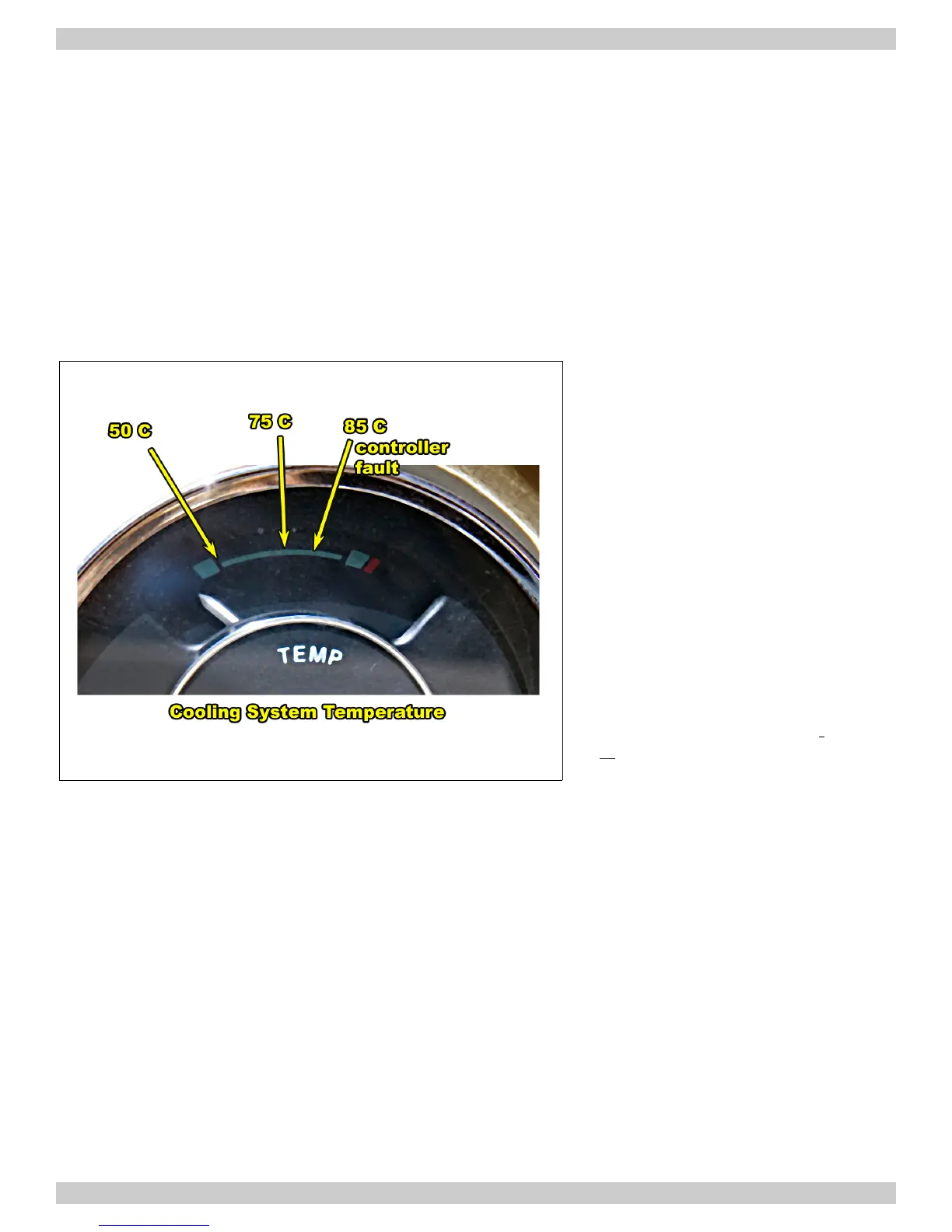
The temperature indicator on the
dash combination gauge does
indicate controller temperature at
the chill plate. In normal operation,
the controller will be operating at
45°-55°C and this needle will be
pretty much at the bottom of the
gauge.
A mid range indication on the meter
would indicate about 75°C. The
controller goes into a current limit
mode, it’s own “limp mode” or
“thermal cutback” at 80°C, or about
¾ gauge indication.
The WarP-Drive Industrial Interface
Module (IM) will also indicate both
motor and controller temperature
as MTemp and CTemp. You can
use the push-buttons to cycle through the various indications from the controller including voltages,
rpm, amperes, MTemp and CTemp.
This has been tested at higher than posted speeds up steep hills in 100°F July weather. The cooling
system, if properly operating, simply does not allow temperatures above 80°C. If you get a gauge
indication past mid-range, check the CTemp on the IM module display. If it is above 80°C, you have
had some failure of the cooling system and need to have it repaired.
Unlike an ICE vehicle, the system does not boil over and strand you. You will not burn up the
controller or electric motor by continuing to drive it. If it does go into limp mode, simply park the
vehicle for a few minutes and let it cool down. Cycle the ignition switch off and back on and you can
continue to drive. The vehicle is perfectly operational.
The cooling system is driven by 12 Volts DC from the switched voltage distribution panel in the engine
bay. Check the fuses there before attempting to have the vehicle repaired.
DRAFT Page 25 of 31 DRAFT
Illustration 18: Motor Temperature Gauge



 To Next Page