The FT Series Heating Only, Boiler
Page 77
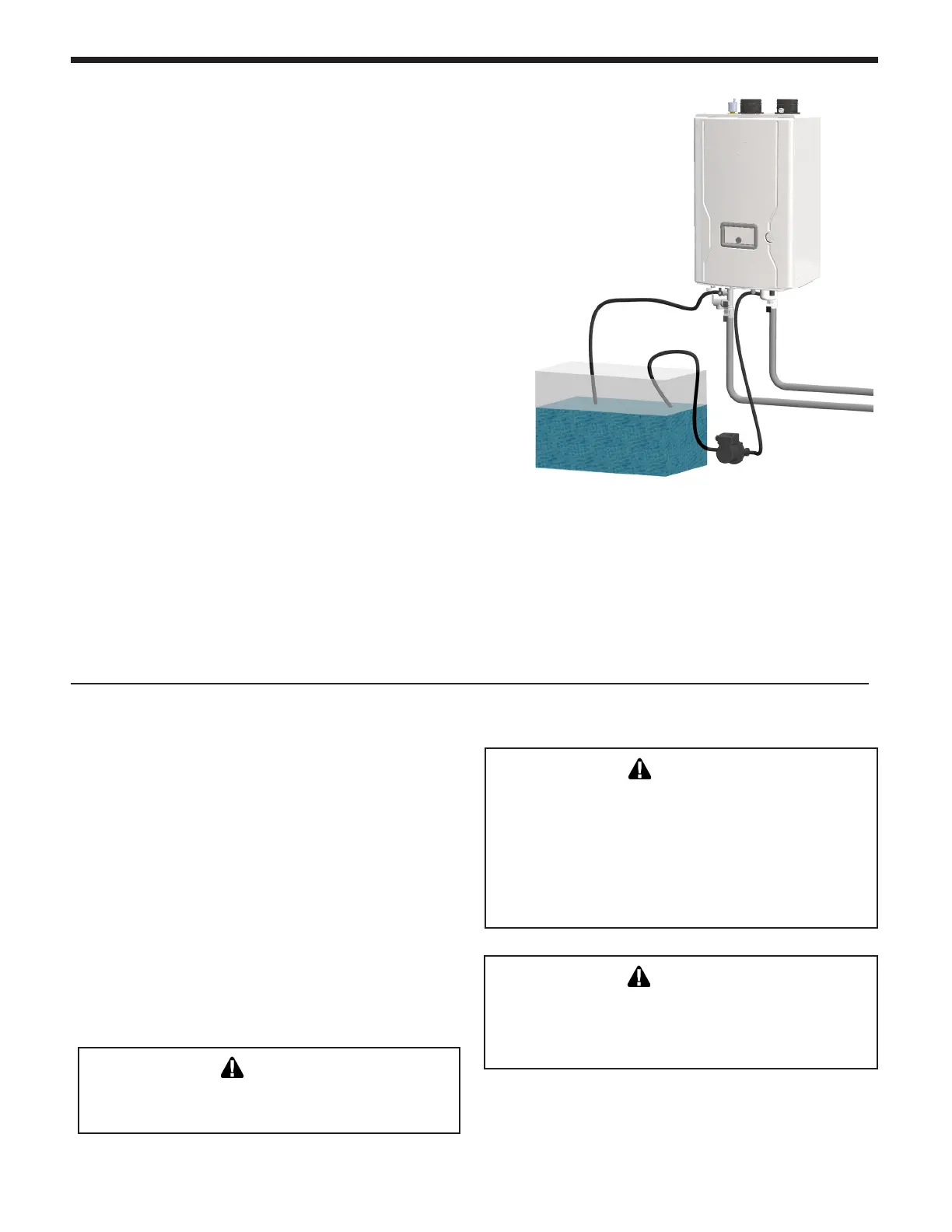
4. Pour the cleaning solution into the bucket.
Place the drain hose (D1) and the hose (D2) to the
pump inlet into the cleaning solution.
5. Open service valves (V3 & V4) on the hot water
outlet and cold water inlet lines.
6. Turn on the circulation pump (Operate the pump and
allow the cleaning solution to circulate through the
boiler for at least 1 hour at a rate of 4 gallons per
minute.)
7. Rinse the cleaning solution from the boiler as follows:
- Remove the free end of the drain hose (D1) from
the bucket.
- Close service valve, (V4), and open shut o valve,
(V2).
Do not open shut o valve, (V1).
- Allow water to ow through the boiler for 5 minutes.
- Close shut o valve (V2).
FT Series Boilers are certied for indoor use only, and
are not design-certied for placement outdoors.
Proper precautions for freeze protection are
recommended for boiler installations in areas where
the danger of freezing exists.
Power outage, interruption of gas supply, failure of
system components, activation of safety devices, etc.,
may prevent a boiler from ring. Any time a boiler
is subjected to freezing conditions, and the boiler
is not able to re, and/or the water is not able to
circulate, there is a risk of freezing in the boiler
or in the pipes in the system. When water freezes,
it expands which may result in bursting of pipes, or
damage to the boiler, which could result in leaking or
ooding conditions.
NOTICE
Not all pumps are capable of maintaining the reduced
temperature rise required with glycol concentrations
greater than 35%.
NOTICE
Do not exceed a 40% glycol concentration by volume
as it may result in short cycling of the burner.
NOTICE
Dierent glycol products may provide varying degrees
of protection. Glycol products must be maintained
properly in a heating system, or they may become
ineffective. Consult the glycol specifications, or the
glycol manufacturer, for information about specific
products, maintenance of solutions, and set up
according to your particular conditions.
8. Ensure service valves (V3 & V4) are closed and shut o valves (V1 & V2) are open.
9. Disconnect all hoses.
10. Remove the cold water inlet lter from the boiler and clean out any residues.
11. Reinsert the lter and ensure the lter cap is securely tightened.
12. Connect electrical power to the boiler.
8.3 Freeze Protection
FT Series Boilers are certied for indoor use only, and
are not design-certied for placement outdoors.
Proper precautions for freeze protection are
recommended for boiler installations in areas where
the danger of freezing exists.
Power outage, interruption of gas supply, failure of
system components, activation of safety devices, etc.,
may prevent a boiler from ring. Any time a boiler
is subjected to freezing conditions, and the boiler
is not able to re, and/or the water is not able to
circulate, there is a risk of freezing in the boiler
or in the pipes in the system. When water freezes,
it expands which may result in bursting of pipes, or
damage to the boiler, which could result in leaking or
ooding conditions.
NOTICE
Not all pumps are capable of maintaining the reduced
temperature rise required with glycol concentrations
greater than 35%.
NOTICE
Different glycol products may provide varying degrees
of protection. Glycol products must be maintained
properly in a heating system, or they may become
ineffective. Consult the glycol specifications, or the
glycol manufacturer, for information about specific
products, maintenance of solutions, and set up
according to your particular conditions.
D3
D2
D1


 To Next Page