506 01 2303 01 17
Specifications are subject to change without notice.
Compressor Overload —
This overload interrupts power to the compressor when
either the current or internal motor winding temperature
becomes excessive, and automatically resets when the
internal tem perature drops to a safe level. This overload
may require up to 60 minutes (or longer) to reset. If the
internal overload is suspected of being open, disconnect
the electrical power to the unit and check the circuit
through the ove rload with an ohmmeter or continuity
tester.
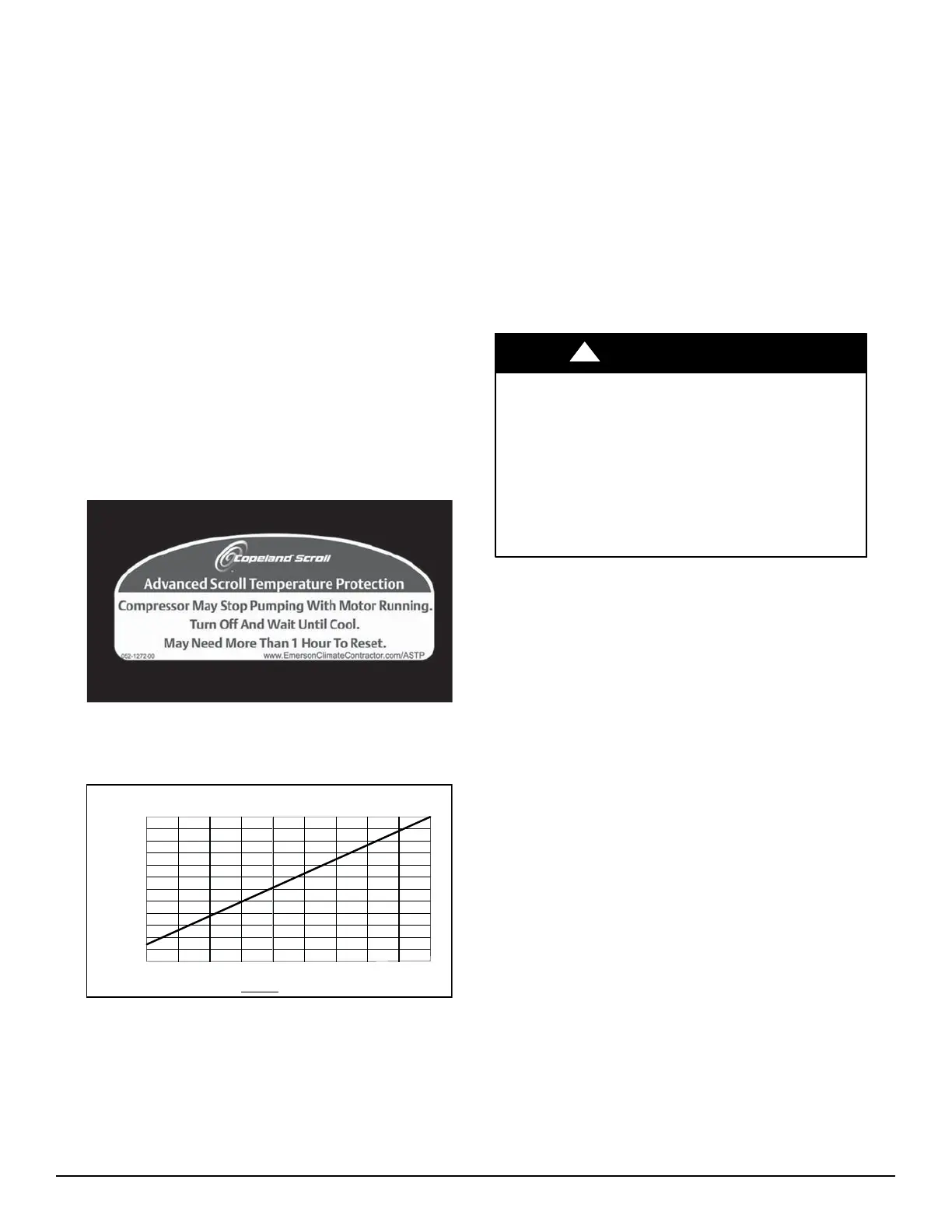
Advanced Scroll Temperature Protection (ASTP) —
A la bel located above the terminal box identifies
Copela nd Scroll compressor models that contain this
tec hnology. See Fig. 13. Advanced Scroll Temperature
Protection (ASTP) is a form of interna l discharge
temperature protection, tha t unloads the scroll compressor
when the internal temperature reaches approximately
300F. At this temperature, an internal bi-metal disk valve
opens and causes the scroll elements to separate, which
stops compression. Suction and discharge pressures
bala nce while the m otor continues to run. The longer the
compressor runs unloaded, the longer it must cool before
the bi-metal disk resets. See Fig. 14.
C10080
Fig. 13 -- Advanced Scroll Temperature
Protection Label
0
10
20
30
40
50
60
70
80
90
100
110
120
0 10 20 30 40 50 60 70 80 90
Compressor Unloaded Run Time (Minutes)
Recommended Cooling Time
(Minutes)
*Times are approximate.
NOTE: Various factors, including high humidity, high ambient
temperature, and the presence of a sound blanket will
increase cool-down times.
C10081
Fig. 14 -- Recommended Minimum Cool-Down Time
After Compressor is Stopped
To manually reset ASTP, the c ompressor should be
stopped and allowed to cool. If the compressor is not
stopped, the motor will run until the motor protector trips,
which occurs up to 90 minutes later. Advanced Scroll
Temperature Protection will reset automatically before the
motor protector re sets, which may take up to 2 hours.
Start Unit —
Disconnect the field low voltage lead at the CHS unit’s R
terminal to prevent compressor operation. Close the CHS
disconnect switch. Only the crankcase heater will be
energized.
Reconnect the field low voltage lead to the CHS unit’s R
terminal. Adjust thermostat setting for Cool below space
temperature.
UNIT DAMAGE HAZARD
Failure to follow this caution may result in equipment
dama ge.
Never charger liquid into the low--pressure side of the
system. Do not overcharge. During charging or
removal of refrigerant, be sure indoor--fan system is
operating. Ensure both outdoor fan motors re running;
bypass any Motormaste r function.
CAUTION
!
Adjust Refrigerant Charge —
The unit must be cha rged in Cooling mode only. Refer to
Cooling Charging Charts, Fig. 15 through Fig. 19. For
applications with line lengths greater tha n 100 ft, conta ct
ICP representative. Vary refrigerant until the conditions of
the chart are met. The charts are based on charging the
units to the correct subcooling for the various opera ting
conditions. Accurate pressure gage and temperature
sensing device are required. Connect the pressure gage to
the service port on the liquid line service valve. Mount the
temperature sensing device on the liquid line close to the
liquid line service valve, and insulate it so that outdoor
ambient temperature does not affect the reading. Indoor
airflow must be within the unit’s normal operating range.
Operate the unit for a minimum of 15 minutes. Ensure
that pressure and temperature readings have stabilized.
Plot the liquid pressure and temperature on chart and add
or reduce the charge to meet the curve. Adjust the charge
to conform with the charging chart, using the liquid
pressure and temperature to read the chart.
Final Checks —
Ensure that all safety controls are operating, control panel
covers are on, and the service panels are in place.



 To Next Page