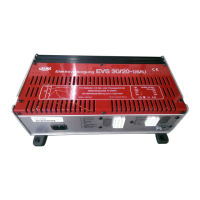
Commissioning
The
power supply
is
operational
as
soon
as
it
is
connected to
the mains.
Disconnect the power cables from the battery and from the
mains before connecting or disconnecting any cables.
At...
Batteries with short-circuited cells must not
be
charged.
LU
Explosion hazard due
to
the generation of oxyhydrogen
gas!
Prerequisites
The
battery must have a rated voltage of
12
V and a minimum
capacity of 70 Ah on the
EVS
36/20-DS/IU and
of
100 Ah on
the
EVS
36/30-DS/IU. lnsufficient charging takes place if the
battery
is
below this value. Batteries with a capacity that
is
too
high are charged too slowly.
The
voltage of the battery may
not have fallen below 1.5
V.
No charging takes place below
this value.
Charging process
Battery charging proceeds automatically. After a mains failure,
the bulk phase
is
automatically started again.
The
bulk phase
ends when a battery voltage of 14.4 V
is
reached. After the
absorption phase, the device switches into the float phase
with constant 13.8
V.
Parallel operation
In
parallel mode the consumer current should
be
less
than the
maximum charging current:
20 A on the
EVS
36/20-DS/IU
30 A on the
EVS
36/30-DS/IU
This
is
the only way
to
ensure that the battery
is
being
charged even though consumers are being supplied.
Procedures
in
the event
of
faults
The
device
is
maintenance-free. However, if any faults do
occur, please proceed according
to
the following table:
36 @
Mains
supplies on board ferries
Power supplies on board ferries may
be
subject
to
strong
fluctuations.
You
should therefore not connect the charger
to
such a power supply.
Generator operation
Please
consult the manufacturer's operating instructions for
the right procedure.
The
generator must comply with the
230 V mains connection values. Only connect the charger to
the generator once the latter
has
achieved running stability,
and disconnect the charger before switching off the genera-
tor. Otherwise, the peak voltages obtained
in
the power-up
and power-down phases could damage the charger.
Maintenance
instructions
At...
The
device must always
be
disconnected from the
LU
mains before any maintenance!
Clean the device and the ventilation slots with a dry, lint-free
cloth.
Fault
The
device
is
not
working.
The
battery
is
not being
charged.
12
V circuits are not
being supplied.
The
battery
II
is
not
charged
in
driving mode.
The
voltage
of
the
battery
II
has
dropped to
below 1.5
V;
the mains
charging process does
not start.
The
maximum charging
current
is
not reached.
None of the faults
described here seems to
apply. But the device still
does not work.
@ 35
Action
- Check the circuit breaker and
the mains connection.
- Check
all
connections from
the charger to the battery.
Pay
attention to the correct polarity.
Unplug the mains plug of the
device and reinsert it.
- Check the fuses and replace
them if necessary.
- Check the connections
to
the
affected circuits.
- Check the connection of the
line D+ from the dynamo and
the fuses.
- Start the motor and let it run
for approx. 30 seconds. battery
voltage rises above 1.5
V.
The
charging process starts
automatically.
-
The
device overheats. Ensure
better ventilation of the device.
Please
contact the manufacturer.


 To Next Page
 Loading...