' &"
! "#$
%&&
Lerchenfeldstr. 9
87600 Kaufbeuren
Tel.: +49(0)8341 / 9764-0 Fax: +49(0)8341 / 67806
42
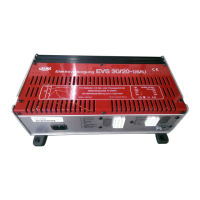
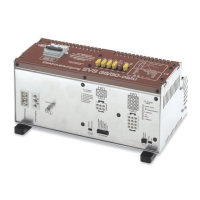
Fig. 21: Mains
connection
Check that all the connections are firm and secure.
Finally implement the mains connection via the female
connector of the mains cable. The socket on the device is
provided with a locking. When connecting the plug, make
sure that the locking engages. In
plug, the locking must be released by lightly raising its
wing.
Commissioning
The power supply is operational as soon as it is connected to the mains.
Before breaking or making direct-current connections, e.g. the charging cable
at the battery, the device be switched off at the mains. Pull out the mains plug.
Never charge batteries with short-circuited cells!
Charging a battery
Explosive gases (oxyhydrogen) are produced if charging is carried out with a
short-circuited battery, or when the automatic charging controller is non-
operational. Therefore it is necessary to ensure sufficient external ventilation in
the battery space. Avoid sparks and open flames!
Prerequisites
The battery must have a rated voltage of 12 volt and a minimum capacity of 70
Ah. Insufficient charging takes place if the battery is below this value. Batteries
with a capacity that is too high are charged too slowly.
Attention
Batteries with short-circuited cells must not be charged. Explosion hazard due
to the generation of oxyhydrogen gas!
Charging process
Battery charging proceeds automatically. After a mains failure, the main
charging process is automatically started again. The main charging process
ends when a battery voltage of 14.4 volt is reached. After the post charging
phase, the device switches to holding charge of constant 13.8 volt.
Parallel operation
In parallel operation, the current drawn up by electrical equipment should be
less than the maximum charging current of 20 A. This is the only way to ensure
that the battery is being charged even though consumers are being supplied.



 To Next Page
 Loading...