17. Aperture, Exposure's Other Half
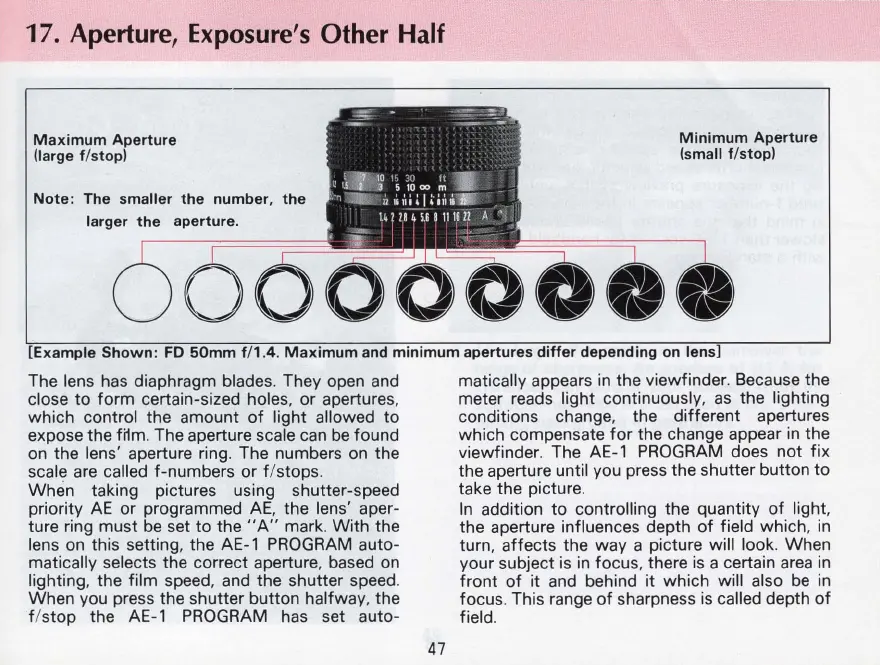
Maximum
Aperture
(large
f/stop)
Note:
The
smaller
the the
Minimum
Aperture
(small
f/stop)
[Example
Shown:
FD
50mm
f/1.4.
Maximum
and
minimum
apertures
differ
depending
on
lens]
The lens has diaphragm blades. They open and
close
to
form
certain-sized holes,
or
apertures,
which control the amount
of
light allowed to
expose the
f~m.
The aperture scale can
be
found
on the
lens' aperture ring. The numbers on the
scale are called f-numbers or f/stops.
When taking pictures using shutter-speed
priority
AE
or programmed
AE,
the lens' aper-
ture ring must
be
set
to
the
"A"
mark. With the
lens on this setting, the AE-1 PROGRAM auto-
matically
selects the correct aperture, based
on
lighting, the film speed, and the shutter speed.
When you press the shutter button
halfway, the
f/stop the AE-1
PROGRAM has set auto-
47
mati cally appears
in
the viewfinder. Because the
meter reads light continuously,
as
the lighting
conditions change, the different apertures
which compensate
for
the change appear
in
the
viewfinder. The AE-1
PROGRAM does not fix
the aperture
until you press the shutter button
to
take the picture.
In
addition
to
controlling the quantity
of
light.
the aperture influences depth
of
field which,
in
turn, affects the way a picture will look. When
your subject
is
in
focus, there
is
a certain
area
in
front
of
it and behind it which will also
be
in
focus. This range
of
sharpness
is
called depth
of
field.





 To Next Page