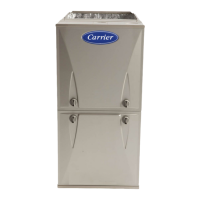
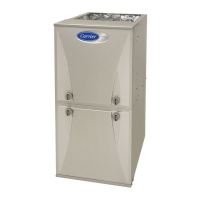
59MN7C: Installation, Start-up, Operating and Service and Maintenance Instructions
Manufacturer reserves the right to change, at any time, specifications and designs without notice and without obligations.
52
A93059
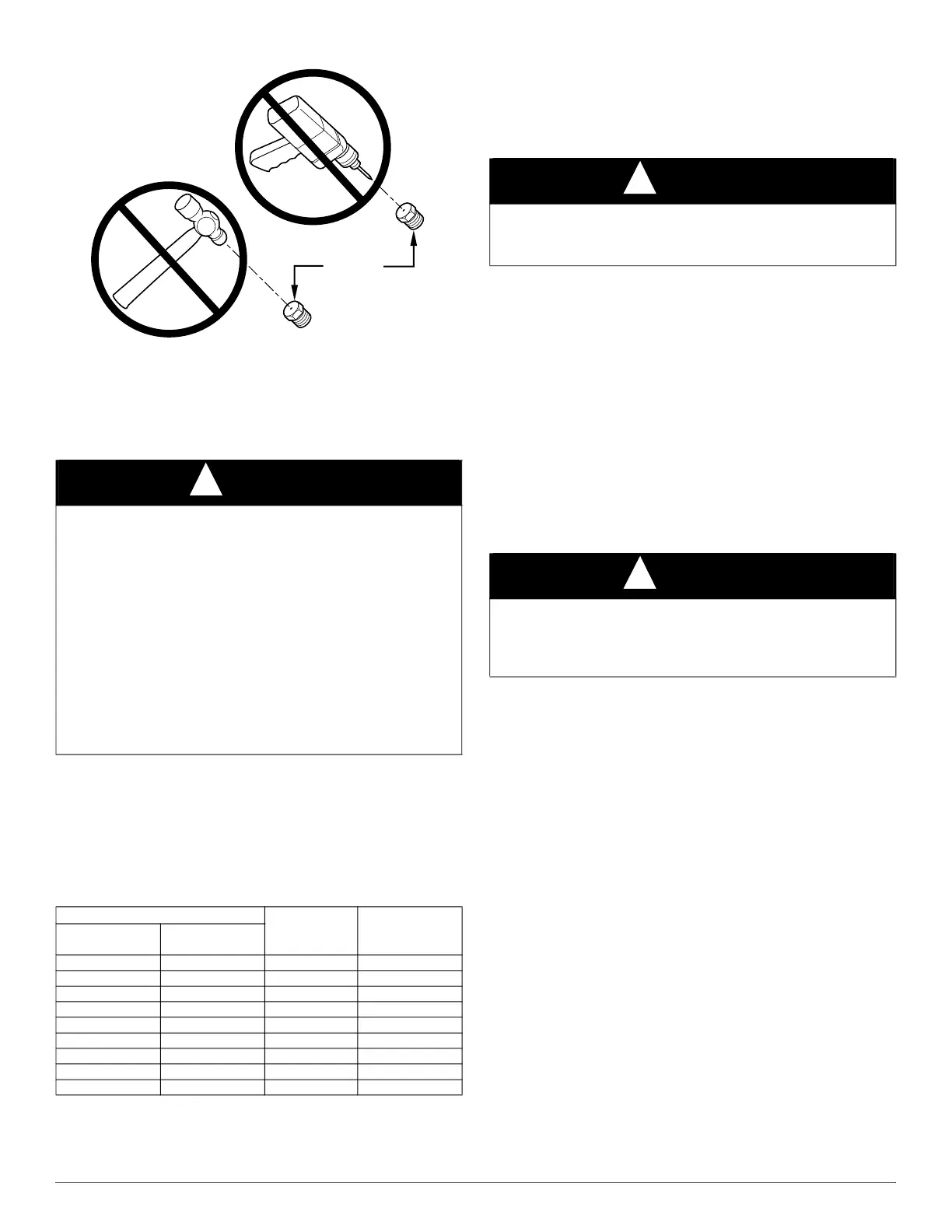
Fig. 62 – Orifice Hole
For proper operation and long term reliability, the Furnace input rate
must be within +/-2 percent of input rate on furnace rating plate or as
adjusted for altitude.
The gas input rate on rating plate is for installations at altitudes up to
2000 ft. (609.6M).
In the USA, the input rating for altitudes above 2000 ft. (609.6M) must
be reduced by 2 percent for each 1000 ft. (304.8M) above sea level.
Refer to Table 20.
In Canada, the input rating must be reduced by 5 percent for altitudes of
2000 ft. (609.6M) to 4500 ft. (1371.6M) above sea level. The natural gas
manifold pressures in Tables 18 and 19 adjust for BOTH altitude and
natural gas heating value.
Table 20 – Altitude Derate Multiplier for U.S.A.*
*Derate multiplier factors are based on midpoint altitude for altitude range.
NOTE: For Canadian altitudes of 2000 to 4500 ft. (610 to 1372 M), use
USA altitudes of 2001 to 2000 ft. (611 to 914 M) in Table 20.
To adjust manifold pressure to obtain the proper input rate, first,
determine if the furnace has the correct orifice installed. At higher
altitudes or different gas heat contents, it may be necessary to change the
factory orifice to a different orifice. Tables have been provided in the
furnace installation instructions to match the required orifice to the
manifold pressure to the heat content and specific gravity of the gas.
To do this:
1. Obtain average yearly gas heat value (at installed altitude) from
local gas supplier.
2. Obtain average yearly specific gravity from local gas supplier.
3. Find installation altitude range for your installation in the manifold
pressure tables. See Table 22 for 20,000 BTUh Max-Heat/8,000
BTUh min-heat per burner or Table 23 for 20,200 BTUh
Max-Heat/8,000 BTUh Min-Heat per burner.
4. Find closest natural gas heat value and specific gravity in Table 22
or Table 23 depending on furnace gas input rate.
5. Follow heat value and specific gravity lines to point of intersection
to find orifice size and maximum and minimum manifold pressure
settings for proper operation.
6. Check and verify burner orifice size in furnace. NEVER ASSUME
ORIFICE SIZE. ALWAYS CHECK AND VERIFY.
7. Replace original orifice with correct size, if required by Table 22 or
Table 23 depending on furnace gas input rate. Use only
factory-supplied orifices, see EXAMPLE 1.
EXAMPLE 1 - 80,000 BTUh INPUT:
EXAMPLE: 0 - 2000 ft. (0 - 609.6M) altitude
Heating value = 1050 Btu/cu ft.
Specific gravity = 0.62
Therefore: Orifice No. 44
* Furnace is shipped with No. 44 orifices. In this example, all main
burner orifices are the correct size and do not need to be changed to
obtain proper input rate.
Manifold pressure: 3.4-in. w.c. for maximum heat, 0.55-in. w.c. for
minimum heat.
NOTE: To convert gas manifold Table pressures to Pascals, multiply the
in. w.c. value by 249.1 Pa/in. w.c. (1 in. w.c. = 249.1 Pa).
Check Inlet Gas Pressure
The inlet gas pressure must be checked with the furnace operating in
maximum heat. This is necessary to make sure the inlet gas pressure
does not fall below the minimum pressure of 4.5 in. w.c. for natural gas.
The maximum inlet gas pressure is 13.6 in. of water column. If the inlet
pressure is too low, you will not be able to adjust the manifold pressure
to obtain the proper input rate. To check the inlet gas pressure:
1. Make sure the gas supply is turned off to the furnace and at the
electric switch on the gas valve.
NOTICE
!
The NATURAL GAS manifold pressure adjustments in Table 22 and
Table 23 compensate for BOTH altitude AND gas heating value. DO
NOT apply an additional derate factor to the pressures show in Table 22
or Table 23. The values in this table are NOT referenced to sea level;
they are AS-MEASURED AT ALTITUDE.
The heating content of natural gas at altitude may already provide for a
reduction in capacity of the furnace. Be sure to obtain the expected
in-season gas heating value of the gas from the gas supplier BEFORE
making any adjustments for capacity or altitude. Refer to Table 22 or
Table 23. No adjustments to the furnace may be necessary at altitude
for certain gas heating values.
Refer to the instructions provided in the factory-specified LP/Propane
conversion kit for instructions for setting gas manifold pressures for
LP/Propane applications.
ALTITUDE PERCENT
OF
DERATE
DERATE
MULTIPLIER
FACTOR*
FT. M
0–2000 0-610 0 1.00
2001–3000 610-914 4-6 0.95
3001–4000 914-1219 6-8 0.93
4001–5000 1219-1524 8-10 0.91
5001–6000 1524-1829 10-12 0.89
6001–7000 1829-2134 12-14 0.87
7001–8000 2134-2438 14-16 0.85
8001–9000 2438-2743 16-18 0.83
9001–10,000 2743-3048 18-20 0.81
NOTICE
!
THERE ARE TWO MANIFOLD PRESSURE TABLES
Use Table 18 for all models EXCEPT 59MN7C060C21--20
Use Table 19 for all models 59MN7C060C21--20 ONLY
NOTICE
!
If orifice hole appears damaged or it is suspected to have been redrilled,
check orifice hole with a numbered drill bit of correct size. Never
redrill an orifice. A burr-free and squarely aligned orifice hole is
essential for proper flame characteristics.


 To Next Page