EasyManua.ls Logo

Casio WK-3000 - User Manual

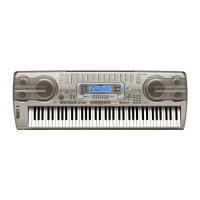
Casio WK-3000
148 pages
Print Icon
To Next Page IconTo Next Page
Loading...
WK3100-E-1
E
USER’S GUIDE
WK3100_e_cover.p65 04.3.26, 0:10 PM1

Table of Contents

Questions and Answers

  • G
    George NguyenSep 3, 2025
    What to do if nothing happens when LAYER or SPLIT button is pressed on Casio WK-3000?
    • V
      Veronica HunterSep 3, 2025
      If nothing happens when you press the LAYER or SPLIT button: * Use the Mixer to turn on Channels 2 through 4. * Use the Mixer to raise the volume setting of Channels 2 through 4. * Note that the LAYER and SPLIT buttons are disabled during recording and record standby. * Turn off the SMF Player Mode because LAYER and SPLIT are not available while the SMF Player Mode is in use.
  • A
    andersonbarbaraSep 1, 2025
    Why does the key or tuning not match when playing along with another MIDI machine on Casio Electronic Keyboard?
    • L
      lbarrettSep 1, 2025
      If the key or tuning doesn't match when playing with another MIDI machine: * Change the transpose or tuning parameter value to 00. * Use the Mixer to change the coarse tune, fine tune, and/or octave shift settings to 00.
  • T
    Tammy WhiteAug 30, 2025
    What to do if a downloaded tone with waveform contains noise on Casio WK-3000?
    • R
      Robert DelacruzAug 31, 2025
      If a downloaded tone with waveform contains noise, or keyboard operations become abnormal when user data is selected, it could be due to corrupted Flash memory. Use the TRANSPOSE/FUNCTION button to perform the system reset operation. If this does not correct the problem, contact your nearest authorized CASIO Service Provider to request maintenance.
  • J
    Joe PowellAug 29, 2025
    Why does my Casio Electronic Keyboard play two tones at once?
    • T
      timothybrownAug 29, 2025
      If your keyboard is playing two tones at once, the Layer function may be turned on. Press the LAYER button to turn off layering.
  • D
    Derek GutierrezAug 27, 2025
    What to do if Casio Electronic Keyboard starts up abnormally?
    • R
      Russell AndersonAug 27, 2025
      If your keyboard starts up abnormally: 1. Remove the batteries and disconnect the AC adapter, then press the POWER button. 2. Reload the batteries and/or reconnect the AC adapter, then press the POWER button again. 3. Use the TRANSPOSE/ FUNCTION button to perform the system reset operation. If this does not solve the problem, contact your nearest authorized CASIO Service Provider to request repair.
  • C
    claytonbrianAug 26, 2025
    How to fix Casio WK-3000 Electronic Keyboard producing unnatural sound when connected to a computer?
    • M
      Mrs. Jessica TurnerAug 26, 2025
      If the sound is unnatural when connected to a computer, the computer’s MIDI Thru function might be turned on. Turn off the MIDI Thru function on the computer or turn off Local Control on the keyboard.
  • J
    jessica59Aug 25, 2025
    What to do if some parts do not play at all during song memory playback on Casio Electronic Keyboard?
    • P
      Phillip MooreAug 25, 2025
      If some parts aren't playing during song memory playback: * Use the Mixer to turn on the channels. * Use the Mixer to check the volume setting.
  • K
    Kathy SmithAug 22, 2025
    What to do if Auto Accompaniment does not sound on Casio Electronic Keyboard?
    • D
      derrick54Aug 22, 2025
      If the auto accompaniment isn't working, check the following: * Increase the volume using the ACCOMP VOLUME button. * Use the Mixer to ensure channels 6 through 10 are turned on. * Use the Mixer to raise the volume setting for channels 6 through 10.

Summary

Safety Precautions

Symbols and Safety Indicators

Explains symbols and safety level indicators used in the manual.

AC Adaptor Precautions

Details important precautions for using the AC adaptor safely.

Water and Foreign Matter Hazards

Explains risks associated with water and foreign matter ingress and necessary steps.

Power Supply

Using Batteries

Explains how to load and replace batteries, and important battery information.

Using the AC Adaptor

Details how to use the specified AC adaptor and important warnings.

Important Battery Information

Lists symptoms of low battery and warnings for battery handling.

Using the Drawbar Organ Mode

Drawbar Organ Tone Selection

Details how to select drawbar organ tones and the function of channel buttons.

Selecting a Drawbar Organ Tone

Guides on finding and selecting drawbar organ tones by number.

Editing a Drawbar Organ Tone

Explains how to change parameters for drawbar organ tones.

Applying Effects to Tones

Selecting a DSP Type

Guides on selecting and editing DSP effect types.

Changing DSP Parameter Settings

Details how to control the strength and application of DSP effects.

Auto Accompaniment

Selecting a Rhythm

Explains how to select rhythms and transfer them from a computer.

Using Auto Accompaniment

Guides on using the auto accompaniment feature with various chord modes.

Using Auto Harmonize

Explains how auto harmonize adds melody notes to chords for richer harmony.

Mixer Function

Using Parameter Edit Mode

Details how to change settings for channels 1-16 in the Mixer.

Editing DSP Channel Parameters

Explains how to select and edit DSP channel parameters.

Synthesizer Mode

Synthesizer Mode Parameters

Lists and describes parameters used for creating original tones.

Tone Characteristic Waveform Parameters

Covers tone setting, attack, release, cutoff, resonance parameters.

Tone Pitch Parameters

Details vibrato type, delay, rate, depth, and octave shift parameters.

Tone Characteristic Setting Parameters

Covers level, touch sense, reverb, chorus, DSP parameters.

Registration Memory

Registration Memory Settings

Lists the settings saved in registration memory for instant recall.

Saving Setups to Registration Memory

Guides on saving keyboard setups into registration memory.

Setup Names and Banks

Explains how to assign setups to areas using bank and registration buttons.

Recalling Setups from Registration Memory

Explains how to recall saved setups from registration memory.

Song Memory Function

Using Real-time Recording

Details how to record keyboard performance in real-time.

Playing Back Songs from Memory

Guides on selecting and playing back recorded songs.

Correcting Mistakes While Step Recording

Explains how to correct input mistakes during step recording.

Recording Melody and Chords with Step Recording

Explains how to record chords and notes step-by-step.

Using the SMF Player

Playing Back SMF Files

Guides on playing back Standard MIDI Files from flash memory, card, or diskette.

MIDI

Using the Data Download Service

Explains how to download data from CASIO MUSIC SITE and transfer it to the keyboard.

Saving Data

Saving Files to External Storage

Details procedures for saving Song Memory, Synthesizer data, etc. to media.

Loading Files from External Storage

Guides on loading data from SmartMedia cards or floppy diskettes into the keyboard.

Troubleshooting

Troubleshooting Common Issues

Provides solutions for common keyboard problems like no sound or abnormal operation.

Specifications

Keyboard Specifications

Details technical specifications for the keyboard, including tones, rhythms, polyphony, and effects.

Casio WK-3000 Specifications

General IconGeneral
Number of Keys76
Polyphony32 notes
SpeakersYes
Weight7.5 kg
Auto AccompanimentYes
Power SupplyAD-12 AC adapter or 6 D-size batteries
DisplayLCD
MIDI16-channel multi-timbre receive
KeyboardTouch Response
Song Memory5 songs
Lesson FunctionYes
Speakers Details12 cm x 2
TerminalsPedal, MIDI IN/OUT
EffectsReverb, Chorus
ConnectionsUSB, MIDI

Related product manuals