12
Collimation
The optical performance of most Newtonian reflecting telescopes can be optimized by re-collimating (aligning) the
telescope's optics, as needed. To collimate the telescope simply means to bring its optical elements into balance.
Poor collimation will result in optical aberrations and distortions.
Before collimating your telescope, take time to familiarize yourself with all its components, using the diagrams on
pages 4 and 5. The primary mirror is the large mirror at the back end of the telescope tube. This mirror is adjusted
by loosening and tightening the three screws, placed 120 degrees apart, at the end of the telescope tube. The
secondary mirror (the small, elliptical mirror under the focuser, in the front of the tube) also has three adjustment
screws. To see what is necessary to go through the following steps, point your telescope toward a bright wall or blue
sky outside (see warning on page 3 regarding safe solar viewing). Once you have collimated your telescope, refer to
the chart on page 15 to confirm that your alignment is correct.
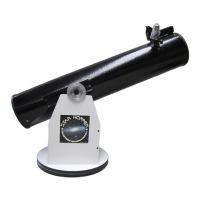
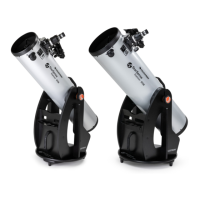
Do not touch the socket head cap screw in the center of the mirror cell of the Star Hopper
®
6
and
8
.
Aligning the Secondary Mirror
If you have an eyepiece in the focuser, remove it. Pull the focuser tube in completely, using the focusing knobs, until
its silver tube is no longer visible. You will be looking through the focuser at a reflection of the secondary mirror,
projected from the primary mirror. During this step, ignore the silhouetted reflection from the primary mirror.
Insert the collimating cap into the focuser and look through it. With the focus pulled in all the way, you should be
able to see the entire primary mirror reflected in the secondary mirror. If the primary mirror is not centered in the
secondary mirror, adjust the secondary mirror screws by alternately tightening and loosening them until the periphery
of the primary mirror is centered in your view. DO NOT loosen or tighten the center screw in the secondary mirror
support, because it maintains proper mirror position.
Aligning the Primary Mirror
Now adjust the primary mirror screws to re-center the reflection of the small secondary mirror, so it’s silhouetted
against the view of the primary. As you look into the focuser, silhouettes of the mirrors should look concentric.
Repeat steps one and two until you have achieved this.
Remove the collimating cap and look into the focuser, where you should see the reflection of your eye in the
secondary mirror.
Night Time Star Collimating
After successfully completing daytime collimation, night time star collimation can be done by closely adjusting the
primary mirror while the telescope tube is on its mount and pointing at a bright star. The telescope should be set up
at night and a star's image should be studied at medium to high power (30-60 power per inch of aperture). If a non-
symmetrical focus pattern is present, then it may be possible to correct this by re-collimating only the primary mirror.
Procedure
(Please read this section completely before beginning)
To star collimate in the Northern Hemisphere, point at a stationary star like the North Star (Polaris). It can be found
in the north sky, at a distance above the horizon equal to your latitude. It’s also the end star in the handle of the Little
Dipper. Polaris is not the brightest star in the sky and may even appear dim, depending upon your sky conditions.





 To Next Page