17
Observing the Sun
Although overlooked by many amateur astronomers, solar observation is both rewarding and fun. However, because
the sun is so bright, special precautions must be taken when observing this star, so as not to damage your eyes or your
telescope. Never project an image of the sun through the telescope. This can damage the telescope and/or any
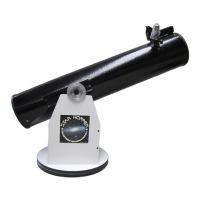
accessories attached to the telescope. For safe solar viewing, use a
Celestron
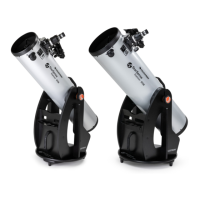
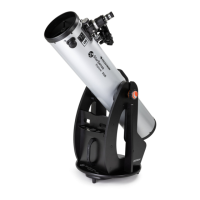
solar filter (available for the
Star
Hopper
®
4
½
and
8
). The filter reduces the intensity of the sun's light, making it safe to view. With this filter you
can see sunspots as they move across the solar disk and faculae, which are bright patches seen near the sun's edge. If
you purchased an optional finderscope, be sure to cover its lens or remove it completely when observing the sun.
This will ensure that the finderscope itself is not damaged and that no one looks through it inadvertently.
Solar Observing Hints
•
The best time to observe the sun is in the early morning or late afternoon, when the air is cooler.
•
To locate the sun without a finderscope, watch the shadow of the telescope tube until it forms a circular shadow.
Observing Deep-Sky Objects
Deep-sky objects are simply those objects outside the boundaries of our solar system. They include star clusters,
planetary nebulae, diffuse nebulae, double stars and other galaxies outside our own Milky Way. Unlike the sun,
moon and our five major planets, most deep-sky objects are not visible to the naked eye. Finding them requires a
method called star hopping, described below.
Celestron
Sky Maps (#93722) can help you locate the brightest deep-
sky objects.
Most deep-sky objects have a large angular size. Therefore, a low-to-moderate power lens is all you need to see them.
Visually, they are too faint to reveal any of the color seen in long exposure photographs. Instead, they appear black
and white. Because of their low surface brightness, they should be observed from a “dark-sky” location. Light
pollution around large urban areas washes out most nebulae making them difficult, if not impossible, to observe.
Star Hopping
One way to find deep-sky objects is by star hopping and a finderscope is very helpful. Star hopping is done by using
bright stars to "guide" you to an object. For successful star hopping, it is helpful to know the field of view of you
telescope. If you’re using the standard
Celestron
25mm SMA ocular, your field of view is more than 1º. If you
know an object is 3º away from your present location, than you just need to move 3 fields of view. If you’re using
another ocular, then consult the section on determining field of view on page 16. Listed below are directions for
locating two popular objects.
The Andromeda Galaxy, also known as M31, is an easy target. To find M31:
1.
Locate the constellation of Pegasus, a large square visible in the fall (in the eastern sky, moving toward the point
overhead) and winter months (overhead, moving toward the west).
2.
Start at the star in the northeast corner—Alpha (
α
) Andromedae.
3.
Move northeast approximately 7°. There you will find two stars of equal brightness—Delta (
δ
) and Pi (
π
)
Andromeda—about 3° apart.
4.
Continue in the same direction another 8°. There you will find two stars—Beta (
β
) and Mu (
µ
) Andromedae—
also about 3° apart.
5.
Move 3° northwest—the same distance between the two stars—to the Andromeda galaxy.





 To Next Page