Ultima 9
1
/
4
and Ultima 11 Manual 40
TRACKING RATE SELECTION
The drive has four basic rates: sidereal, lunar, solar, and King (which is a
modified sidereal rate that takes into account atmospheric refraction). Sidereal
rate is the rate at which the stars move and is based on a single rotation of the
Earth which takes 1,436.5 minutes. The lunar and solar rates are for the Moon
and Sun respectively, both of which move relative to the background stars.
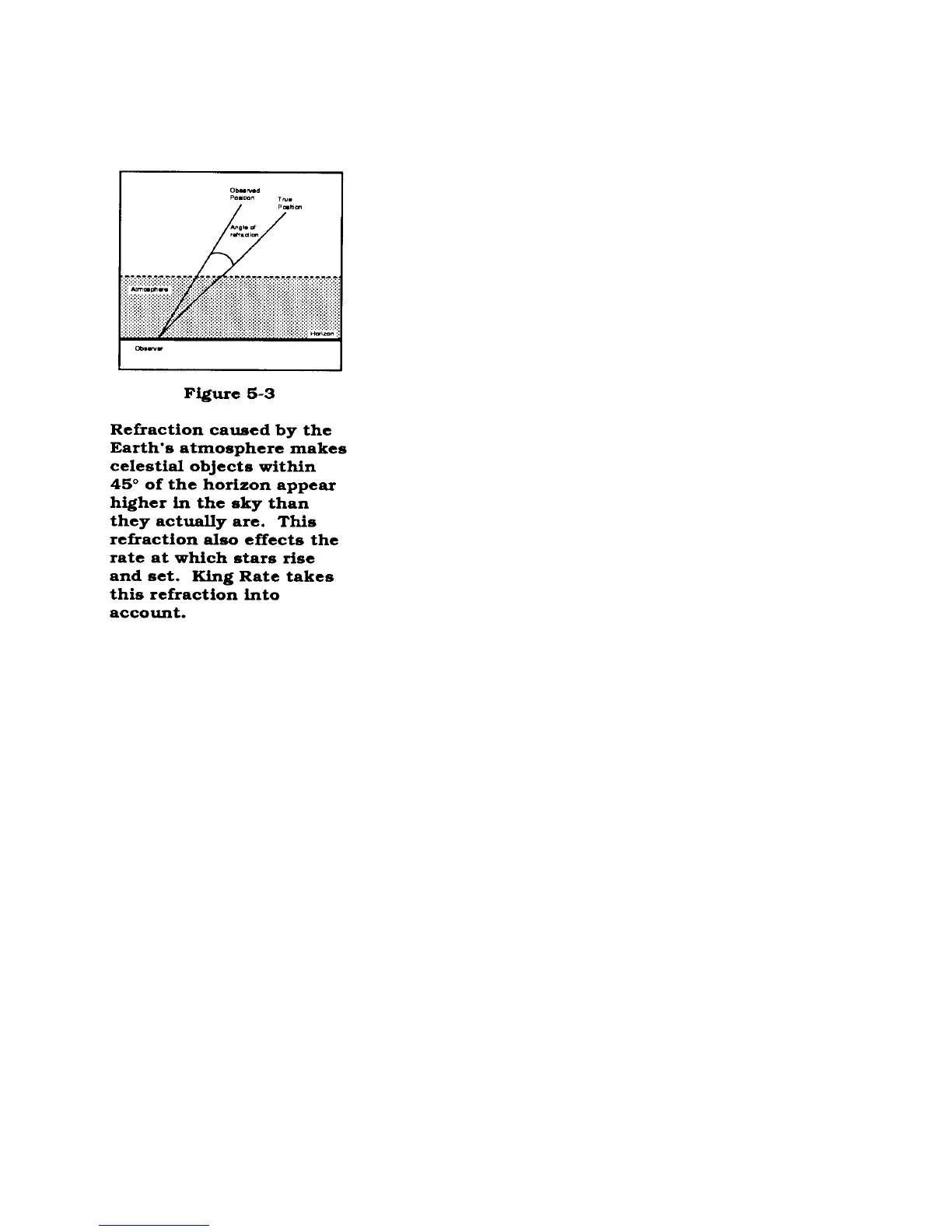
For more accurate sidereal tracking there is King rate. An astronomer by the
name of King discovered that atmospheric refraction affects the apparent motion
of objects across the sky. The King rate takes into account this refraction
caused by the Earth’s atmosphere and is recommended for deep sky
astrophotography. For deep sky observing, either King or sidereal rate is fine.
Each of the tracking rates is represented by an icon. Sidereal rate is represented
by a star (★), lunar rate by a crescent moon (), solar rate by a sun (✳), and
King rate by a crown. Underneath each icon is an LED to indicate which rate
has been selected. Once the power has been turned on, the drive tracks at
sidereal rate, the default tracking rate. To change the tracking rate, press the
‘RATE’ button. Pressing the button once changes the drive rate once. The rates
are selected sequentially from left-to-right as listed above.
Note that the PEC function does NOT have to be activated for the drive to work.
However, once PEC is activated, the drive rate is locked on the one selected.
You can not change rates until PEC is turned off.
PERIODIC ERROR CORRECTION
Periodic Error Correction, or PEC for short, is a system that improves the
tracking accuracy of the drive by reducing the number of user corrections. PEC
is designed to improve photographic quality by reducing the amplitude of the worm errors. Using the PEC function
is a two-step process. First, you must guide for at least four minutes during which time the system records the
corrections you make. (It takes the worm gear four minutes to make one complete revolution, hence the need to
guide for four minutes.) This ‘teaches’ the PEC chip the characteristics of the worm gear. The second step is to play
back the corrections you made during the recording phase. Keep in mind, this feature is for advanced
astrophotographers and requires careful guiding.
Definition: Periodic error is a slight oscillation of the mount caused by imperfections in the drive gears. The rate
of the periodic error is equal to the rotation of the [worm] gear, in this case four minutes. Note that
ALL telescope drives have some periodic error.
Here’s how to use the PEC function most effectively.
1. Find a bright star relatively close to the object you want to photograph.
2. Insert a high power eyepiece with illuminated cross hairs into your telescope. Orient the guiding eyepiece
cross hairs so that one is parallel to the declination axis while the other is parallel to the R.A. axis.
3. Center the guide star on the illuminated cross hairs, focus the telescope, and study the periodic movement.




 To Next Page