Telescope Maintenance 55
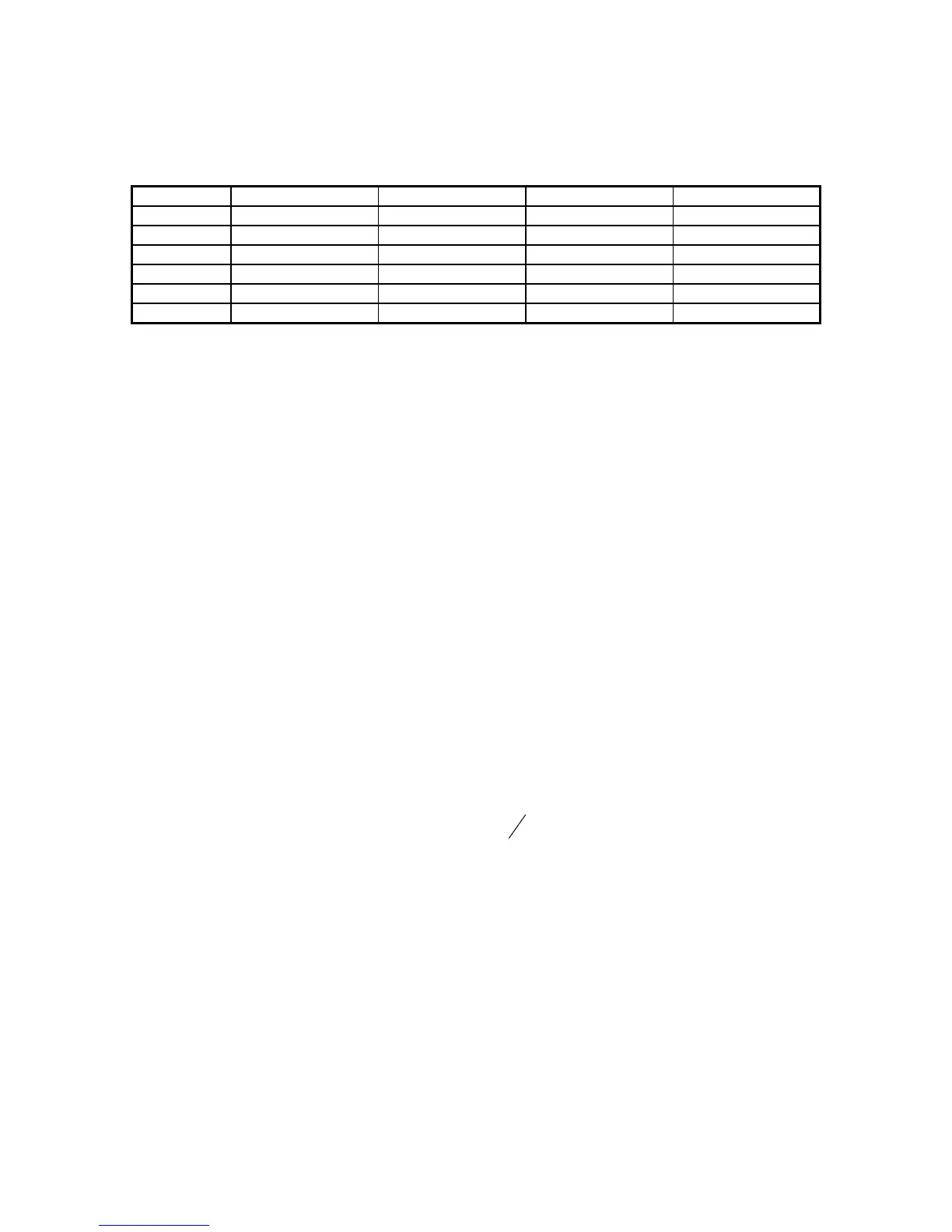
The following table lists exposures for eyepiece projection with a 10mm eyepiece. All exposure times are
listed in seconds or fractions of a second.
Planet ISO 50 ISO 100 ISO 200 ISO 400
Moon
4 2 1 1/2
Mercury
16 8 4 2
Venus
1/2 1/4 1/8 1/15
Mars
16 8 4 2
Jupiter
8 4 2 1
Saturn
16 8 4 2
Table 7-2
The exposure times listed here should be used as a starting point. Always make exposures that are longer
and shorter than the recommended time. Also, take a few photos at each shutter speed. This will ensure
that you get a good photo. It is not uncommon to go through an entire roll of 36 exposures and have only
one good shot.
NOTE: Don't expect to record more detail than you can see visually in the eyepiece at the time you are
photographing.
Once you have mastered the technique, experiment with different films, different focal length eyepieces,
and even different filters.
Effective Focal Length
The effective focal length of the optical system for eyepiece projection is given by this formula:
E F L Magnification DF...=×
where DF is the distance from the center of the eyepiece to the film and magnification is the focal length of
the telescope divided by the focal length of the eyepiece.
Effective Magnification
To determine the magnification when using eyepiece projection, use the equation
EM
EFL
..
...
=
50
where
E.F.L. is the effective focal length , in millimeters and E.M. is the effective magnification.




 To Next Page