Ultima 9
1
/
4
and Ultima 11 Manual 45
CELESTIAL OBSERVING
With your telescope set up, you are ready to use it for observing. This section covers visual observing for both solar
system and deep sky objects.
OBSERVING THE MOON
In the night sky, the Moon is a prime target for your first look because it is extremely bright and easy to find. Often,
it is tempting to look at the Moon when it is full. At this time, the face we see is fully illuminated and its light can be
overpowering. In addition, little or no contrast can be seen during this phase.
One of the best times to observe the Moon is during its partial phases (around the time of first or third quarter).
Long shadows reveal a great amount of detail on the lunar surface. At low power you will be able to see most of the
lunar disk at one time. The optional Reducer/Corrector lens allows for breath-taking views of the entire lunar disk
when used with a low power eyepiece. Change to higher power (magnification) to focus in on a smaller area. Keep
in mind that if you are not using the clock drive, the rotation of the Earth will cause the Moon to drift out of your
field of view. You will have to manually adjust the telescope to keep the Moon centered. This effect is more
noticeable at higher power. If you are using the clockdrive and have polar aligned, the Moon will remain centered if
using the lunar tracking rate. Consult your local newspaper or a current astronomy magazine to find out when the
Moon is visible.
Lunar Observing Hints
• To ensure accurate tracking, be sure to select lunar tracking rate.
• To increase contrast and bring out detail on the lunar surface, use filters. A yellow filter works well at
improving contrast.
OBSERVING THE PLANETS
Other easy targets include the five naked eye planets. You can see Venus go through its lunar-like phases. Mars can
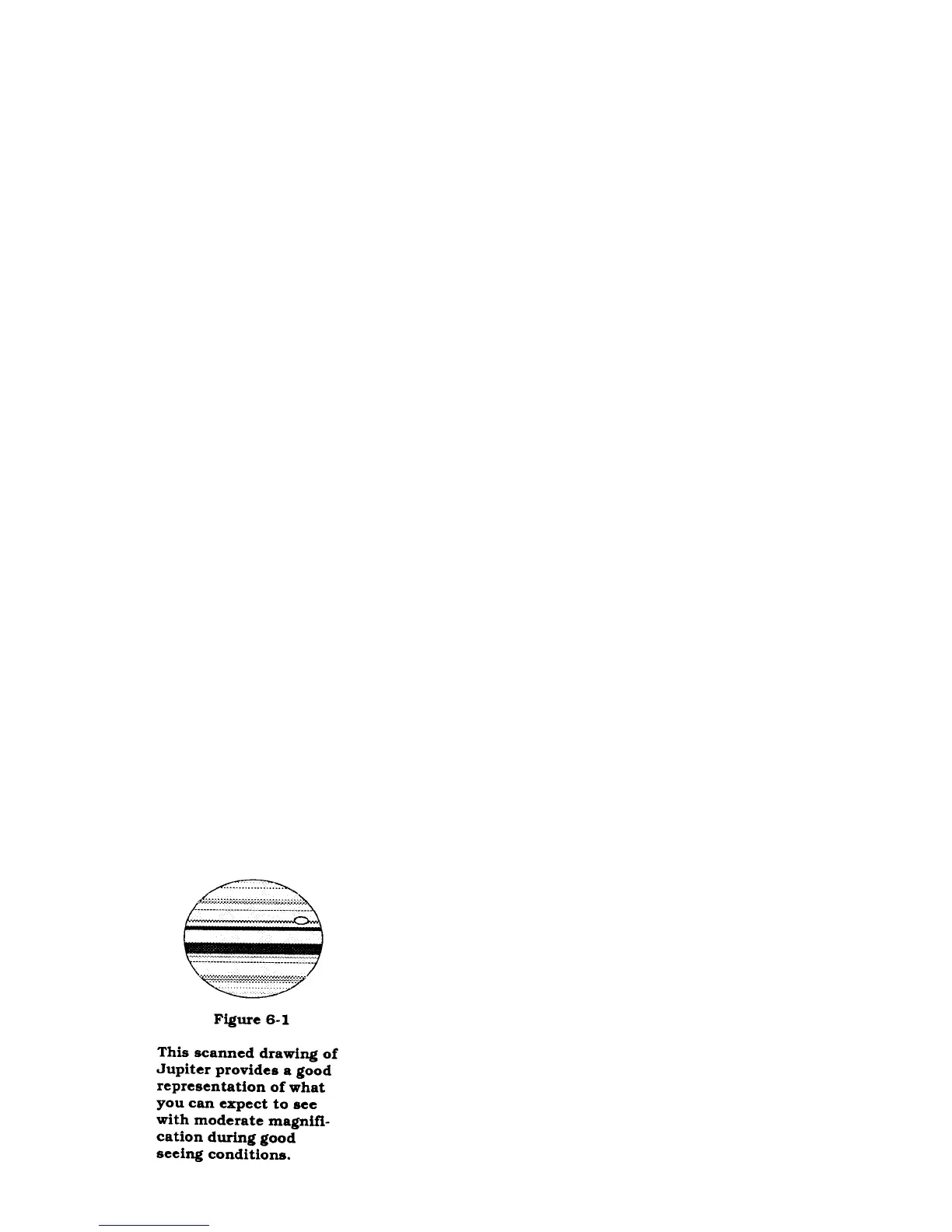
reveal a host of surface detail and one, if not both, of its polar caps. You will be able to see the cloud belts of Jupiter
and the great Red Spot (if it is visible at the time you are observing). In addition, you will also be able to see the
moons of Jupiter as they orbit the giant planet. Saturn, with its beautiful rings, is easily visible at moderate power.
All you need to know is where to look. Most astronomy publications indicate where the planets are in the sky each
month.
Planetary Observing Hints
• King or sidereal rates work best for tracking the planets
• To increase contrast and bring out detail on the planetary surface, try using
Celestron eyepiece filters.
OBSERVING THE SUN
Although overlooked by many amateur astronomers, solar observation is both
rewarding and fun. However, because the Sun is so bright, special precautions



 To Next Page