Ultima 9
1
/
4
and Ultima 11 Manual 50
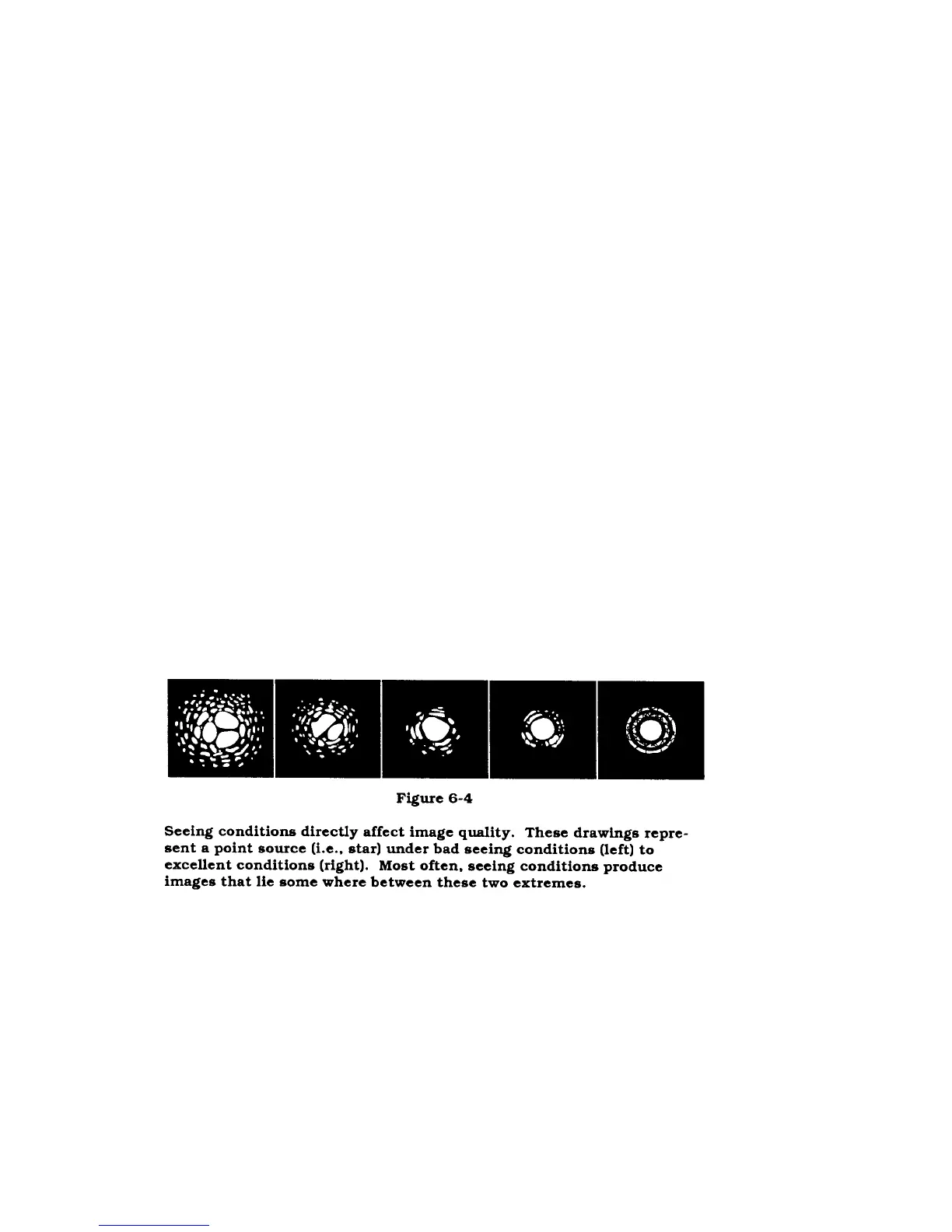
like Jupiter and Mars, and stars are pinpoint images. Under poor seeing conditions, images are blurred and stars
appear as blobs. Seeing conditions are rated on five-point scale where one is the worst and five is the best (see figure
6-4). Seeing conditions can be classified in one of three categories which are based on the cause.
Type 1 seeing conditions are characterized by rapid changes in the image seen through the telescope. Extended
objects, like the Moon, appear to shimmer while point sources (i.e., stars) appear double. Type 1 seeing is caused by
currents within or very close to the telescope tube. These currents could be caused by a telescope that has not
reached thermal equilibrium with the outdoor surroundings, heat waves from people standing near the telescope, or
heated dew caps. To avoid the problems associated with Type 1 seeing, allow your telescope approximately 45
minutes to reach thermal equilibrium. Once adjusted to the outdoor temperature, don't touch the telescope tube with
your hands. When pointing the telescope, hold the Ultima by the handle on the rear cell. If observing with others,
make sure no one stands in front of or directly below the telescope tube.
The images produced by Type 2 seeing conditions don't move as quickly as those produced by Type 1 conditions,
but the images are quite blurry. Fine detail is lost and the contrast is low for extended objects. Stars are spread out
and not sharp. The source of Type 2 seeing is the lower atmosphere, most likely heat waves from the ground or
buildings. To avoid the problems associated with Type 2 seeing, select a good observing site. Look for broad hill
tops or open grassy fields. Stable thermal conditions found near lakes and atmospheric inversions also tend to
produce good seeing. Avoid sites that overlook asphalt parking lots or plowed fields. Stay away from valleys and
shorelines. If you can't get a better location, wait until the early morning hours when the surroundings are uniformly
cool and the seeing is generally better.
Type 3 seeing conditions are characterized by fast ripples, but sharp images. In extended objects fine detail is
visible, but the images shift around the field. Stars are crisp points, but they shift small distances rapidly around the
field. The cause of Type 3 seeing is turbulence in the upper atmosphere which means the observer has less control
over it. However, the effects of Type 3 seeing are generally less pronounced than the other two types. You can never
really avoid Type 3 seeing. Your best bet is to wait until moments of steadiness. If the seeing is extremely bad, pack
up and wait for a better night.
The conditions described here apply to both visual and photographic observations.




 To Next Page