EasyManua.ls Logo

Cessna T188C - Page 15

Cessna T188C
624 pages
Print Icon
To Next Page IconTo Next Page
To Previous Page IconTo Previous Page
Loading...
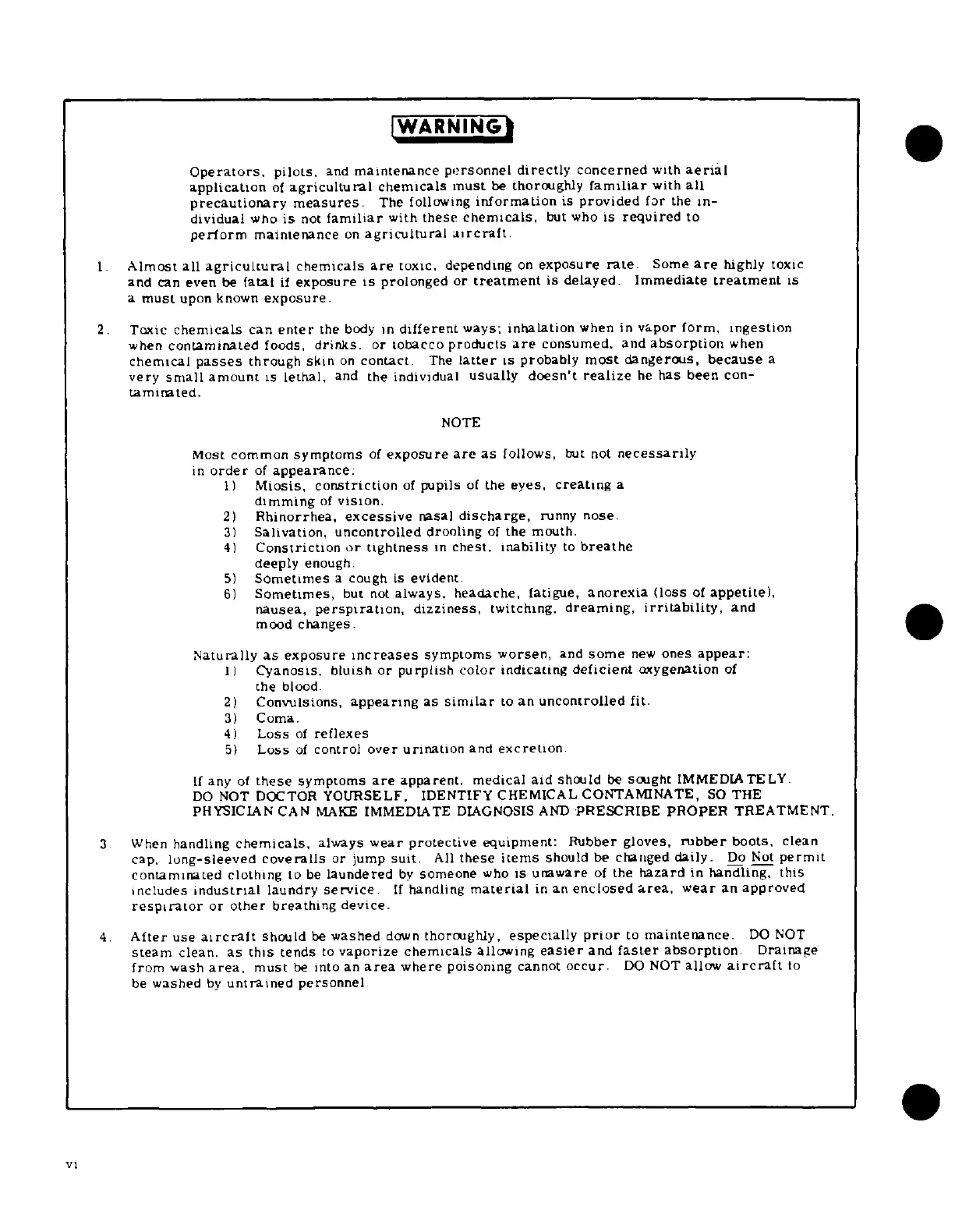
Operators.
pilots,
and
maintenance
personnel directly
concerned
with
aerial
application
of
agricultural
chemicals
must
be
thoroughly
familiar
with
all
precautionary measures.
The
following
information
is
provided
for
the
in-
dividual
who
is
not
familiar
with
these
chemicals,
but
who
is
required
to
perform
maintenance
on
agricultural
aircraft.
1
Almost
all
agricultural
chemicals
are
toxic, depending
on
exposure
rate.
Some
are
highly
toxic
and
can
even
be
fatal
if
exposure
is
prolonged
or
treatment
is
delayed.
Immediate
treatment
is
a
must
upon
known
exposure.
2.
Toxic
chemicals
can
enter
the
body
in
different
ways: inhalation
when
in
vapor
form,
ingestion
when
contaminated
foods,
drinks.
or
tobacco
products
are
consumed, and
absorption
when
chemical
passes
through
skin
on
contact.
The
latter
is
probably
most
dangerous,
because
a
very
small
amount
is
lethal,
and
the
individual
usually
doesn't
realize
he
has been
con-
taminated.
NOTE
Most
common
symptoms
of
exposure
are
as
follows,
but
not
necessarily
in
order
of
appearance:
1)
Miosis,
constriction
of
pupils
of
the
eyes,
creating
a
dimming
of
vision.
2)
Rhinorrhea,
excessive
nasal
discharge,
runny
nose.
3)
Salivation,
uncontrolled
drooling
of
the
mouth.
41
Constriction
or
tightness
in
chest.
inability
to
breathe
deeply
enough.
5)
Sometimes
a
cough
is
evident.
6)
Sometimes,
but
not
always,
headache,
fatigue,
anorexia
(loss
of
appetite),
nausea,
perspiration,
dizziness,
twitching,
dreaming,
irritability,
and
mood
changes.
Naturally
as
exposure
increases
symptoms
worsen,
and
some
new
ones
appear:
1)
Cyanosis.
bluish
or
purplish
color
indicating
deficient
oxygenation
of
the
blood.
2)
Convulsions,
appearing
as
similar
to
an
uncontrolled
fit.
3)
Coma.
4)
Loss
of
reflexes
5)
Loss
of
control
over urination
and
excretion
If
any
of
these
symptoms
are
apparent.
medical
aid
should
be
sought
IMMEDIATELY.
DO
NOT
DOCTOR
YOURSELF.
IDENTIFY
CHEMICAL
CONTAMINATE,
SO
THE
PHYSICIAN
CAN
MAKE
IMMEDIATE
DIAGNOSIS
AND
PRESCRIBE
PROPER
TREATMENT.
3
When
handling
chemicals,
always
wear
protective
equipment:
Rubber
gloves,
rubber
boots,
clean
cap.
long-sleeved
coveralls
or
jump
suit.
All
these
items
should
be
changed
daily.
Do
Not
permit
contaminated
clothing
to
be
laundered
by
someone
who
is
unaware
of
the
hazard
in
handling,
this
includes
industrial
laundry
service.
If
handling
material
in
an
enclosed
area,
wear
an
approved
respirator
or
other
breathing
device.
4.
After
use
aircraft
should
be
washed
down
thoroughly,
especially
prior
to
maintenance.
DO
NOT
steam
clean,
as this
tends
to
vaporize
chemicals
allowing
easier
and
faster
absorption.
Drainage
from
wash
area,
must
be
into
an
area
where
poisoning
cannot
occur.
DO
NOT
allow
aircraft
to
be
washed
by
untrained
personnel
vi

Table of Contents

Related product manuals