Chapter 4
Donning and Doffing
Edition 1 – December 2019 SAFETY FIRST 117
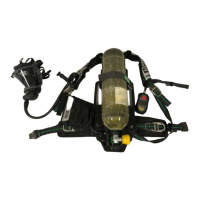
MSA G1 Electronic Breathing Apparatus
Safety consideration
Take these safety considerations into account when performing buddy breathing
During buddy breathing movement towards safety must be coordinated. The
firefighter being rescued (receiver) should follow the lead of the firefighter
supplying air (provider).
BA operators must ensure that they do not get their buddy breathing hose
entangled in objects and must move in a coordinated fashion so that they do
not pull each other
off-balance.
BA operators must remember that it is extremely difficult for two people to
leave a hazardous atmosphere quickly while buddy breathing and
simultaneously consuming air at a faster rate. Most problems with any form
of buddy breathing take place while operators are attempting to move
towards safety.
The risk of both the provider and receiver exhausting their air supplies is a
possibility associated with buddy breathing. What starts out as a rescuer-
victim relationship ends up a victim-victim relationship, as the shared air
supply is exhausted before exiting is possible.
It is for this reason operators should recognise and react to potential
situations that could disorient, entangle, entrap or injure themselves.
Buddy breathing is a last resort emergency procedure.
Buddy breathing connection valves
may
rarely have cause to jam in the
‘open’ position allowing air to flow between 6 to 8 bar at up to 700 litres per
minute depending on size of leak. If the valve does jam into the ‘open’
position, re-insert and dis-connect up to three times to try and re-seat valve.
If the valve has not re-seated, place the cap over the leaking valve and hold
it as tight as possible to reduce air flow and
immediately
make way to fresh
air.
A replacement BA operator should enter to provide assistance to the
casualty if still required.


 To Next Page