20
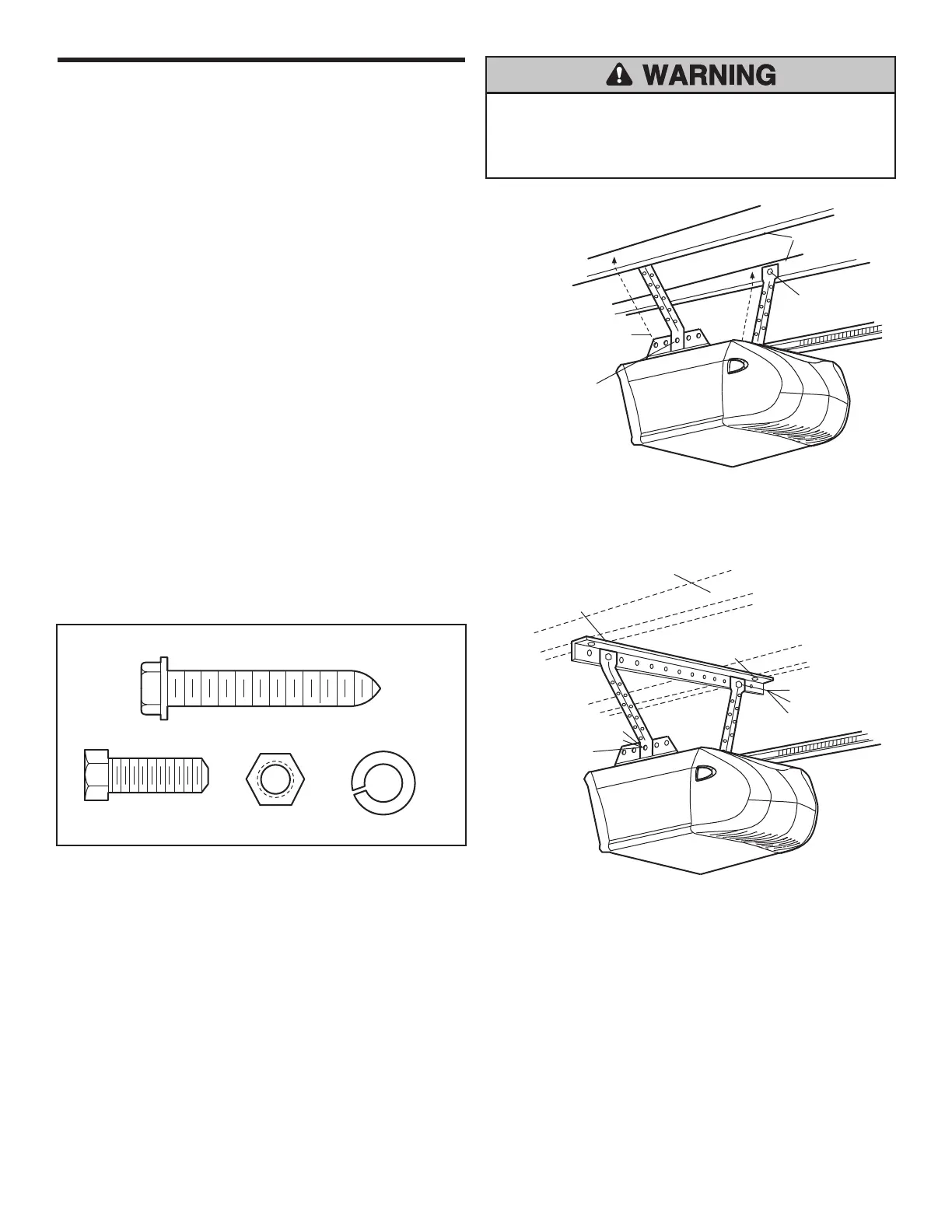
Bracket
(Not Provided)
Lag Screws
5/16"-18x1-7/8"
(Not Provided)
Bolt 5/16"-18x7/8"
Lock Washer 5/16"
Nut 5/16"-18
— FINISHED CEILING —
Hidden
Support
Bolt 5/16"-18x7/8"
Lock Washer 5/16"
Nut 5/16"-18
Hex Bolt
5/16"-18x7/8"
Nut 5/16"-18 Lock Washer 5/16"
Lag Screw
5/16"-18x1-7/8"
INSTALLATION STEP 5
Hang the Opener
Two representative installations are shown. Yours may be
different. Hanging brackets should be angled (Figure 1) to provide
rigid support. On fi nished ceilings (Figure 2), attach a sturdy metal
bracket to structural supports before installing the opener. This
bracket and fastening hardware are not provided.
1. Measure the distance from each side of the motor unit to the
structural support.
2. Cut both pieces of the hanging bracket to required lengths.
3. Drill 5 mm pilot holes in the structural supports.
4. Attach one end of each bracket to a support with
5/16"-18x1-7/8" lag screws.
5. Fasten the opener to the hanging brackets with 5/16"-18x7/8"
hex bolts, lock washers and nuts.
6. Check to make sure the T-rail is centered over the door (or in
line with the header bracket if the bracket is not centered above
the door).
7. Remove the 38 mm board. Operate the door manually. If the
door hits the rail, raise the header bracket.
8. Grease the top and underside of the rail surface where the
trolley slides with rail grease.
To avoid possible SERIOUS INJURY from a falling garage
door opener, fasten it SECURELY to structural supports of
the garage. Concrete anchors MUST be used if installing ANY
brackets into masonry.
Measure
Distance
Lag Screws
5/16"-18x1-7/8"
Structural
Supports
Bolt 5/16"-18x7/8"
Lock Washer 5/16"
Nut 5/16"-18
Figure 1
Figure 2
HARDWARE SHOWN ACTUAL SIZE
13 mm Socket Wrench





 To Next Page