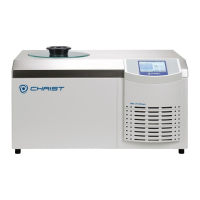
Need help?
Do you have a question about the Christ ALPHA 1-2 LDplus and is the answer not in the manual?
Defines freeze drying (Lyophilisation) as extraction of water from frozen material via sublimation.
Lists applications of the ALPHA 1-2 LDplus for laboratory and pre-production freeze drying.
Provides performance, physical, and electrical specifications for the ALPHA 1-2 LDplus freeze dryer.
Refers to the enclosed EU Declaration of Conformity for standards and regulations.
Details critical safety warnings including disconnecting mains, handling solvents, cleaning, and transport.
Warns to disconnect the mains plug before opening panels or for maintenance.
Advises caution with solvents, especially azides, due to explosion risks and unit damage.
Mentions observing safety regulations for infectious, toxic, pathogenic, and radioactive substances.
Warns about limbs freezing to surfaces in the ice condenser chamber during operation.
Provides instructions for safe transport, advising two-person carrying and avoiding the control panel.
Lists prohibited freeze drying processes including incorrect installation and hazardous substances.
Explains freeze drying (sublimation) as a gentle process, detailing components.
Details pre-operation steps, including warming up the vacuum pump and its importance.
Describes freezing methods for small and large quantities, including shell or spin freezing.
Explains the main drying phase, factors affecting duration, and the role of the vacuum pump.
Describes the final drying phase, its dependence on ice condenser temperature and vacuum.
Explains how to determine the end of drying and the aeration process to vent the chamber.
Details the process of defrosting the ice condenser using room temperature or warm water.
Describes drying products on shelves outside the ice condenser chamber after pre-freezing.
Details drying and sealing injection bottles under vacuum or inert gas using a sealing device.
Explains drying liquids in flasks outside the chamber using manifolds and rubber valves.
Describes the process of freezing and drying liquids in ampoules outside the chamber.
Advises on proper placement, alignment, ambient temperature, and air circulation for the freeze dryer.
States that the supply voltage must match the nameplate and the unit is safety class I.
Specifies that the freeze dryer should be protected with a 16 AG fuse.
Describes checking the earth connection using a screw and a measuring device.
Explains the use of the aeration and drain valve for venting or flooding the ice condenser chamber.
Details draining condensate and defrosting water via the aeration/drain valve, ensuring proper hose setup.
Advises on managing vacuum pump exhaust, recommending an exhaust filter for oil mist.
Provides a caution to ensure correct installation before initial start-up.
Identifies and labels the functional components and control elements of the freeze dryer.
Illustrates connection diagrams for vacuum sensor, pump, and pressure control valve.
Explains how to switch on the unit and the initial tutorial sequence for the LDplus control system.
Introduces the LDplus system as a user interface for controlling freeze drying processes.
Identifies the components of the LDplus control panel: display, softkeys, and navigation keys.
Explains how to operate the LDplus control system using the touch-sensitive panel and navigation keys.
Describes the three areas of the LC display: Main window, Status bar, and Softkey function.
Explains that the main window shows set values, actual values, menus, and process information.
Details the status bar's function in showing operating mode, active phase, and other relevant information.
Describes the operating modes: Standby, Run mode (timer deactivated/activated).
Details the active phases: Freezing, WarmUp VP, Main drying, and Final drying.
Explains the function of the info icon for error and process messages.
Explains that softkeys have dynamic functions displayed next to them for easy operation.
Describes the values window, showing measuring channels like time and vacuum.
Explains how to select modes and phases (Freezing, Warm-up, Main drying, Final drying).
Guides on starting a drying process from standby mode, including vacuum pump warm-up inquiry.
Explains how to change phases or stop the process while it is running.
Describes the timer function and user inquiries for continuing or stopping phases.
Explains how to access the main menu using the right softkey to navigate options.
Details how to define set values for freezing, main drying, and final drying phases.
Explains setting the timer for the freezing phase, including infinite duration.
Explains setting timer and vacuum values for main and final drying phases.
Describes accessing special functions for accessories like defrosting or lifting devices.
Refers to a chapter for detailed information on error messages and the process/equipment information system.
Lists options available in the menu: Contrast, Language, Settings, and Service.
Explains how to adjust the LC display contrast to suit local lighting conditions.
States the LDplus system supports German, English, French, Spanish, and Polish.
Covers settings for warm-up time and automatic phase change.
Describes the service menu for LDplus configuration and loading default settings.
Explains how to start the LDplus control system tutorial.
Explains the display of the process & equipment information window for messages and status.
Describes the different status indicators for information messages (acknowledged, not acknowledged).
Details special functions like defrosting the ice condenser and using the electrical lifting device.
Explains the process of defrosting the ice condenser using electrical heating.
Describes using the electrical lifting device to move the drying chamber.
Discusses the impact of power failure on the drying process and how to handle it.
Provides troubleshooting steps for insufficient vacuum, checking valves and connections.
Offers checks for when the unit display does not work after operating the mains switch.
Explains reasons for insufficient ice condenser temperature, such as ambient conditions or air circulation.
Refers to a chapter for error messages and details on the process and equipment information system.
Lists and explains various error messages, their causes, and recommended actions.
Advises ensuring the ice condenser chamber is free of residue before start-up and drying.
Recommends checking and cleaning the heat exchanger periodically to maintain performance.
Details the maintenance and adjustment procedures for the VSP62 vacuum sensor.
Explains the limited service life of the tungsten wire in vacuum sensors and how to avoid damage.
Describes when to replace the vacuum sensor and how to perform its adjustment and calibration.
Provides detailed steps for adjusting the vacuum sensor using its buttons.
Explains how to adjust the sensor to a specific zero reference value.
Emphasizes checking rubber valves and maintaining them by dismantling, cleaning, and greasing.
Refers to the separate manual for vacuum pump maintenance and highlights oil level checks and oil changes.
Advises on managing condensate in the exhaust filter and refers to its manual.
Details cleaning procedures for the freeze dryer and its accessories.
Recommends using mild agents for cleaning the freeze dryer and leaving the lid open.
Stresses considering safety measures for accessories and regular cleaning to prevent damage.
Highlights the importance of maintaining aeration and drain valves to prevent faulty operation.
Lists suitable disinfectants and notes checking material compatibility for disinfection.
Outlines essential safety checks for the operator, including lid, seals, and accessories.
Mentions the LPC-32 software as an available option.
Mentions the LPC-32 software with PC hardware as an available option.
Mentions LyoLog LL-1 documentation software as an available option.
Mentions the LDplus Simulation Tool as a training software option.
 General
| Type | Condenser dryer |
|---|---|
| Capacity | 8 kg |
| Energy efficiency class | A++ |
| Noise level | 65 dB |
| Number of programs | 16 |
| Color | White |
| Dimensions (H x W x D) | 85 cm x 60 cm x 60 cm |

 To Next Page