CIAS Elettronica S.r.l. Ed. 1.5
Installation Handbook Page 36 of 57 MANTA 50 – 80
2.7 How to calculate the size of the beam and dead zones
In order to calculate theoretically the dimension of the microwave beam and the dead zones
generated with respect to the variable distance between TX and RX, CIAS has created a simple
application called
CIAS Volumeter
available for free on our website: www.cias.it
or on App Store to the following link:
https://itunes.apple.com/it/app/cias-volumeter/id409397666?mt=8
or on Google play to the following
link:
https://play.google.com/store/apps/details?id=it.mi.action.ciasvolumeter
2.8 Microwave working plane
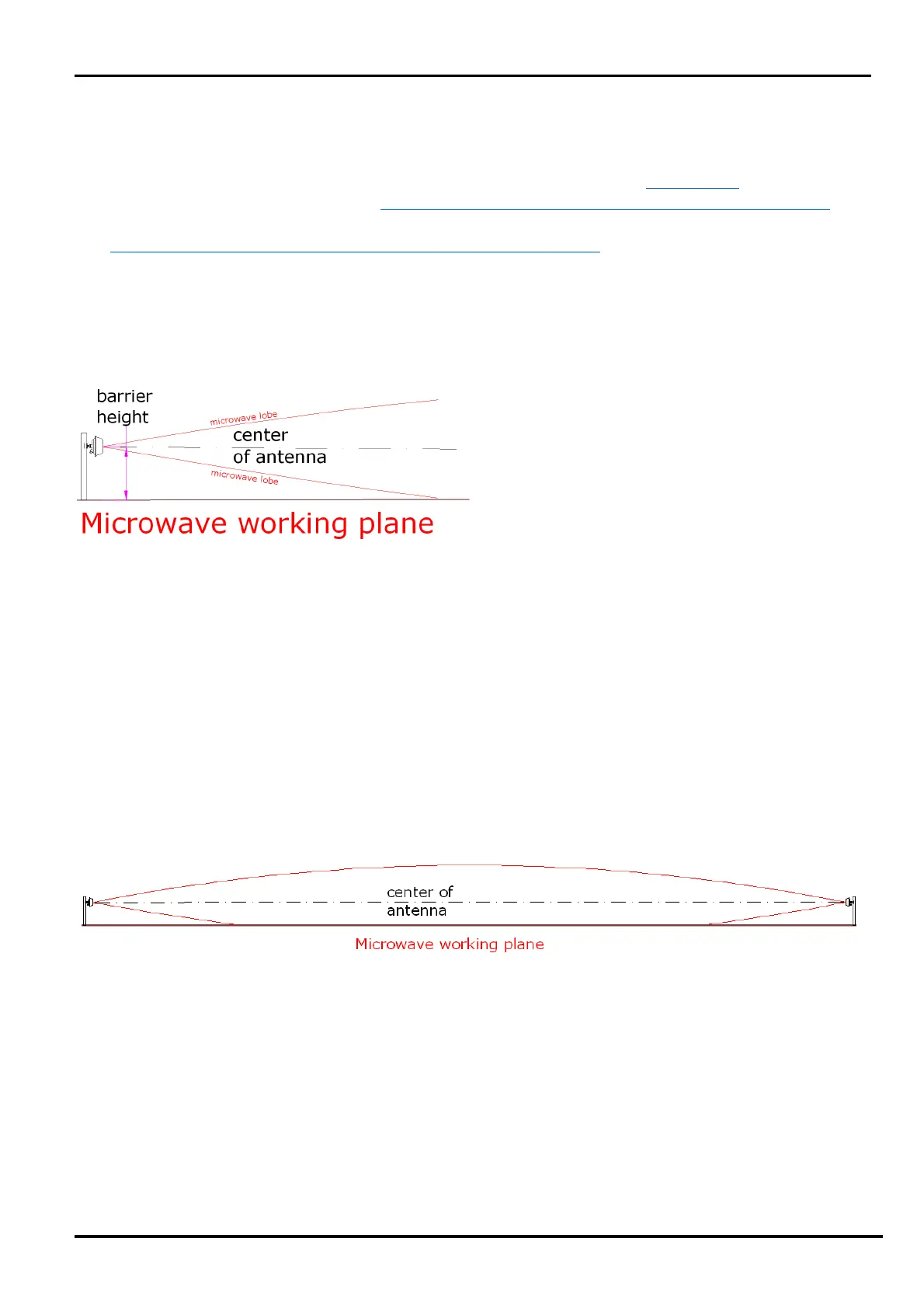
The working plane is the surface which supports the microwave beam, granting the proper
functioning of the barrier.
Distance between the center of the antenna and the working plane is called
height of the barrier
and must be chosen depending on the type of ground surface (asphalt, concrete, self-locking,
grass, etc.).
•
The working plane
MUST
necessarily be one
•
Near a wall or metallic fence it could happen that the microwave "consider" two planes, i.e.
the wall/fence and the ground
•
The correct height is obtained through the incorporated alignment tools
•
Microwave field stability is required
1° Example
Pole on the same level of microwave working plane
This is the simplest solution for installation, because the working plane is flat and the poles
are at the same height.


 To Next Page