EasyManua.ls Logo

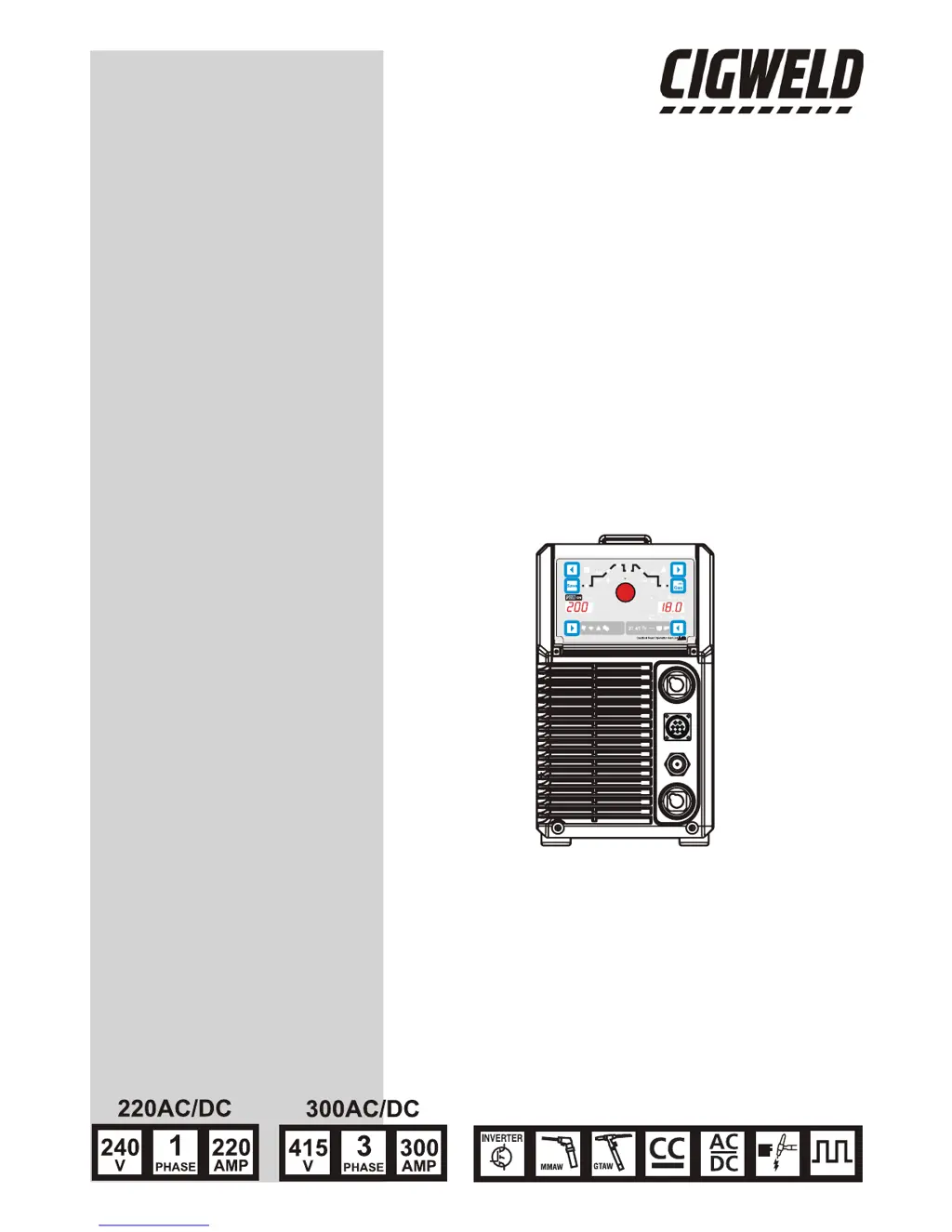
CIGWELD Transtig 220 AC/DC - User Manual

CIGWELD Transtig 220 AC/DC
104 pages
Print Icon
To Next Page IconTo Next Page
Loading...
Art # A-12276
220AC/DC
300AC/DC
Service Manual
Revision: AB Issue Date: March 4, 2014 Manual No: 0-5292
Operating Features:
TRANSTIG
WELDING MACHINE

Table of Contents

Questions and Answers

  • C
    Catherine ReyesSep 18, 2025
    What to do if welding output voltage is not present when torch trigger depressed on CIGWELD Welding System?
    • R
      Robert LynchSep 18, 2025
      A faulty trigger switch or lead could be the reason. Repair or replace the torch/trigger lead.
  • B
    Brad Webb PhDAug 25, 2025
    Why welding arc cannot be established with my CIGWELD Transtig 220 AC/DC Welding System?
    • A
      Amanda DelgadoAug 25, 2025
      If the welding arc cannot be established, make sure the work clamp is connected to the work piece and the work/torch leads are connected to the right welding terminals. Also, ensure the torch lead is connected to the correct terminal. Check that the gas flow is correctly set, the cylinder isn't empty, and the torch valve is ON. Select the right flow rate, change cylinders or turn torch valve ON.
  • D
    Devin AyalaAug 25, 2025
    What to do if gas flow won’t shut OFF on my CIGWELD Welding System?
    • L
      latoyadorseyAug 26, 2025
      If the gas flow won’t shut OFF, it could be because the Weld Mode was changed before the POST-FLOW gas time had finished, the gas valve is faulty or jammed open, or the POST-FLOW control is set to 60 seconds. Strike an arc to complete the weld cycle, or switch the machine OFF then ON to reset the solenoid valve sequence. Have an accredited Cigweld Service Provider repair or replace the gas valve. Reduce POST-FLOW time.
  • K
    Kristina GarrettAug 27, 2025
    Why does welding current reduce when using CIGWELD Transtig 220 AC/DC?
    • E
      Evan WoodsAug 27, 2025
      If the welding current reduces when welding, you should tighten all welding cable connections and use the proper size and type of cable. Refer to Section 2.05 Electrical Input Requirements. Replace the electrode and verify output torch connections. The issue might be due to loose welding cable connections, incorrect welding cable size, improper input connections, poor electrode condition, or wrong welding polarity.
  • R
    Randall ObrienSep 22, 2025
    What to do if welding output voltage is present but arc cannot be established with CIGWELD Welding System?
    • B
      Brian HillSep 22, 2025
      This could be due to poor or no work lead contact. Clean the work clamp area and ensure good electrical contact.
  • J
    Jackie HardySep 23, 2025
    Why is there no HF output in HF mode on my CIGWELD Welding System?
    • P
      palmerjorgeSep 23, 2025
      The HF circuit may be faulty. Have an Accredited CIGWELD Service Provider check the HF circuit.
  • B
    Brian FosterSep 9, 2025
    How to prevent slag inclusion in CIGWELD Transtig 220 AC/DC welds?
    • O
      owenscraigSep 10, 2025
      If non-metallic particles are trapped in the weld metal (slag inclusion), it could be due to particles trapped in undercut from a previous run, joint preparation that is too restricted, irregular deposits, lack of penetration, rust or mill scale, or using the wrong electrode for the welding position. Clean slag out and cover with a run from a smaller diameter electrode if undercut is present. Allow for adequate penetration and room for cleaning out the slag. Chip or grind out irregularities if very bad. Use a smaller electrode with sufficient current to give adequate penetration and remove all slag from corners. Clean the joint before welding. Use electrodes designed for the welding position.
  • J
    Jerry MartinezSep 12, 2025
    Why weld run does not fuse to the surface with CIGWELD Welding System?
    • Z
      zacharycampbellSep 12, 2025
      If portions of the weld run don't fuse to the surface of the metal or edge of the joint, it could be due to small electrodes used on heavy cold plate, welding current that is too low, the wrong electrode angle, a travel speed that is too high, or scale/dirt on the joint surface. Use larger electrodes and pre-heat the plate. Increase the welding current. Adjust the electrode angle. Reduce the travel speed. Clean the surface before welding.
  • C
    charles37Sep 3, 2025
    How to fix excessive bead build-up with CIGWELD Welding System?
    • E
      Elizabeth JohnstonSep 3, 2025
      If you're getting excessive bead build-up, poor penetration, or poor fusion at the edges of the weld, it's likely the welding current is too low. Increase the weld current and/or check for faulty joint preparation.
  • K
    Kimberly WhiteSep 1, 2025
    Why does the electrode melt when I strike an arc with my CIGWELD Transtig 220 AC/DC Welding System?
    • S
      Sean JohnsonSep 1, 2025
      If the electrode melts when the arc is struck, it could be because the electrode is connected to the ‘+’ terminal or the WAVE BALANCE is greater than 50%. Connect the electrode to the ‘?’ terminal. Reduce WAVE BALANCE to below 50% or increase the electrode size.

CIGWELD Transtig 220 AC/DC Specifications

General IconGeneral
Output Current Range (AC)10-220A
AC Frequency50/60 Hz
TIG WeldingYes
Stick WeldingYes
Pulse WeldingYes
AC Balance AdjustmentYes
Duty Cycle (at 160A)60%
Welding ProcessTIG/Stick
AC/DCAC/DC

Related product manuals