
 Need help?
Do you have a question about the Cisco MERAKI MR44 and is the answer not in the manual?
Provides instructions on installation, configuration, and troubleshooting.
Details the physical aspects like interfaces and power requirements.
Covers operating environment, storage, humidity, and physical security options.
Options for physically securing the access point after installation.
Description of Ethernet ports and available power source options.
Information on factory reset button and LED status indicators.
Crucial safety precautions and warnings for installation.
Steps for preparing the network and firmware before installation.
Guidelines for selecting an optimal mounting location for the AP.
Detailed steps for mounting the AP using various methods.
Specific instructions for mounting the AP on a drop ceiling T-rail.
Instructions for mounting the AP on a junction box.
Steps to secure the MR44 AP to the installed mount cradle.
Instructions for placing the AP on a desk or shelf.
Steps to check LEDs, connectivity, and network coverage.
Configuring upstream firewall settings and IP addressing.
Common troubleshooting procedures and Ethernet port checks.
Details on warranty coverage and how to contact support.
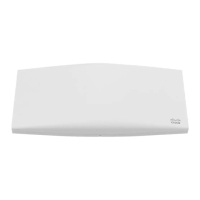
The Cisco Meraki MR44 is a dual-band enterprise-class 802.11ax cloud-managed access point designed for high-capacity and high-density environments. It is engineered to meet the demands of the most challenging network settings, providing robust wireless connectivity. In addition to its primary function of delivering Wi-Fi, the MR44 includes a third radio specifically dedicated to optimizing the RF environment and enhancing airwave security. This ensures a stable and secure wireless experience, even in congested areas.
The MR44 offers various usage features to enhance its functionality and adaptability. It supports both Power over Ethernet (PoE) and a 12V DC input for power, providing flexibility in deployment. When operating in low power mode, the MR44 intelligently adjusts its performance to conserve energy. This includes downshifting its Ethernet uplink speed from 2.5 Gbps to 1 Gbps, transitioning its 5GHz radio from 4x4:4 to 2x2:2, disabling its dedicated IoT radio (previously known as BLE), and reducing its maximum Tx power. These adjustments ensure efficient operation while maintaining essential connectivity. For initial installation, it is crucial to connect the MR44 to an 802.3at-capable (PoE+) switch/power injector or ensure the network is set to MR 27.6 firmware or newer. Using 802.3af with older firmware (MR 27.5/27.5.1 or lower) may lead to unexpected behaviors like reboots or degraded performance. Therefore, downgrading to older firmware versions is not recommended if powered by an 802.3af switch/power injector.
The device is equipped with a multi-color LED indicator on the front to convey system functionality and performance status. An orange LED indicates the AP is booting, with a permanent orange suggesting a hardware issue. A rainbow LED signifies initialization or scanning. A blinking blue LED means the AP is upgrading, while a solid green or blue LED indicates gateway mode (green for no clients, blue for clients). A blinking orange LED signals that the AP cannot find an uplink. Additionally, the MR44 can be operated in "Run Dark" mode, which disables the LED for enhanced security and reduced visibility, a feature configurable through the Meraki Dashboard. The device also includes a factory reset button; pressing and holding it for at least five seconds and then releasing it will reboot the AP and restore it to its original factory settings, deleting all stored configuration information.
For physical security, the MR44 offers multiple options. It comes with two security screw options (13.5 mm long, 2.5 mm diameter, 5 mm head) that can be used to secure the access point to its mount cradle, preventing accidental dislodging and theft. A Kensington lock hardpoint is also integrated, allowing the device to be secured to any nearby permanent structure using a standard Kensington lock cable. The concealed mount plate with an anti-tamper cable bay further enhances security by hiding cables and making unauthorized removal more difficult.
Maintenance features for the MR44 include basic troubleshooting steps. If the access point does not connect, users can try factory resetting the device by holding the factory reset button for 5 seconds, or switching cables and testing them on another device. To check radio functionality, the AP can be configured as a repeater by disconnecting the Ethernet cable from the LAN. If it broadcasts an SSID appended with "-scanning" and allows connection to my.meraki.com, the radio is functional. To check Ethernet port functionality, users can disable their computer's wireless adapter, set the Ethernet adapter to obtain an IP address automatically via DHCP, and connect to the AP's Ethernet port. A solid green or blue Ethernet LED indicates proper functionality. If the LED does not turn solid, swapping cables or trying a second Ethernet port (if available) is recommended. For static IP address configuration, users can verify the MAC address on my.meraki.com and configure the static IP, net mask, gateway IP, and DNS servers via the "Uplink Configuration" tab.
The MR44 is designed for easy installation with its mount cradle, which supports various scenarios including wall, solid ceiling, drop ceiling, and electrical junction box mounts. The mount cradle includes a built-in level tool and a template to guide drilling and hole patterns. The accessory kit for drop ceiling mounts includes clips and set screws for secure attachment to different T-rail sizes. The AP attaches to the mount cradle with two tabs and is secured with one screw. To release the AP, the security screw is removed, and the bottom tab is pressed upwards. For desk or shelf installations, the mount cradle is not necessary, as the AP can rest on its non-scratch rubber feet.
The device is intended for industrial or commercial activities and is not for domestic use. It should be installed and maintained by qualified specialists. Disposal of the device at the end of its service life must comply with all state regulations and laws, and it should not be discarded with household waste. The equipment should be stored in its original packaging in a room protected from atmospheric precipitation, adhering to specified temperature and humidity ranges. Transportation should also be carried out in covered vehicles, ensuring compliance with permissible temperature and humidity ranges during storage. For additional support and warranty information, users can log into dashboard.meraki.com and visit the Get Help section to open a case or find contact information. The MR44 comes with a lifetime warranty for the device and Ethernet cables included in the box, subject to specific terms and conditions.
 General
| Frequency Bands | 2.4 GHz, 5 GHz |
|---|---|
| Antenna Type | Internal |
| Operating Temperature | 0°C to 40°C (32°F to 104°F) |
| Wi-Fi Standards | 802.11a/b/g/n/ac/ax |
| Ethernet Ports | 1 x 100/1000/2.5GBASE-T Ethernet (RJ45) |
| Power over Ethernet | 802.3at |
| Bluetooth | Bluetooth Low Energy (BLE) |
| Mounting | Wall, Ceiling |


 To Next Page