EasyManua.ls Logo

Commodore PC 10 - Page 112

Commodore PC 10
494 pages
Print Icon
To Next Page IconTo Next Page
To Previous Page IconTo Previous Page
Loading...
130
MS-DOS User's Guide
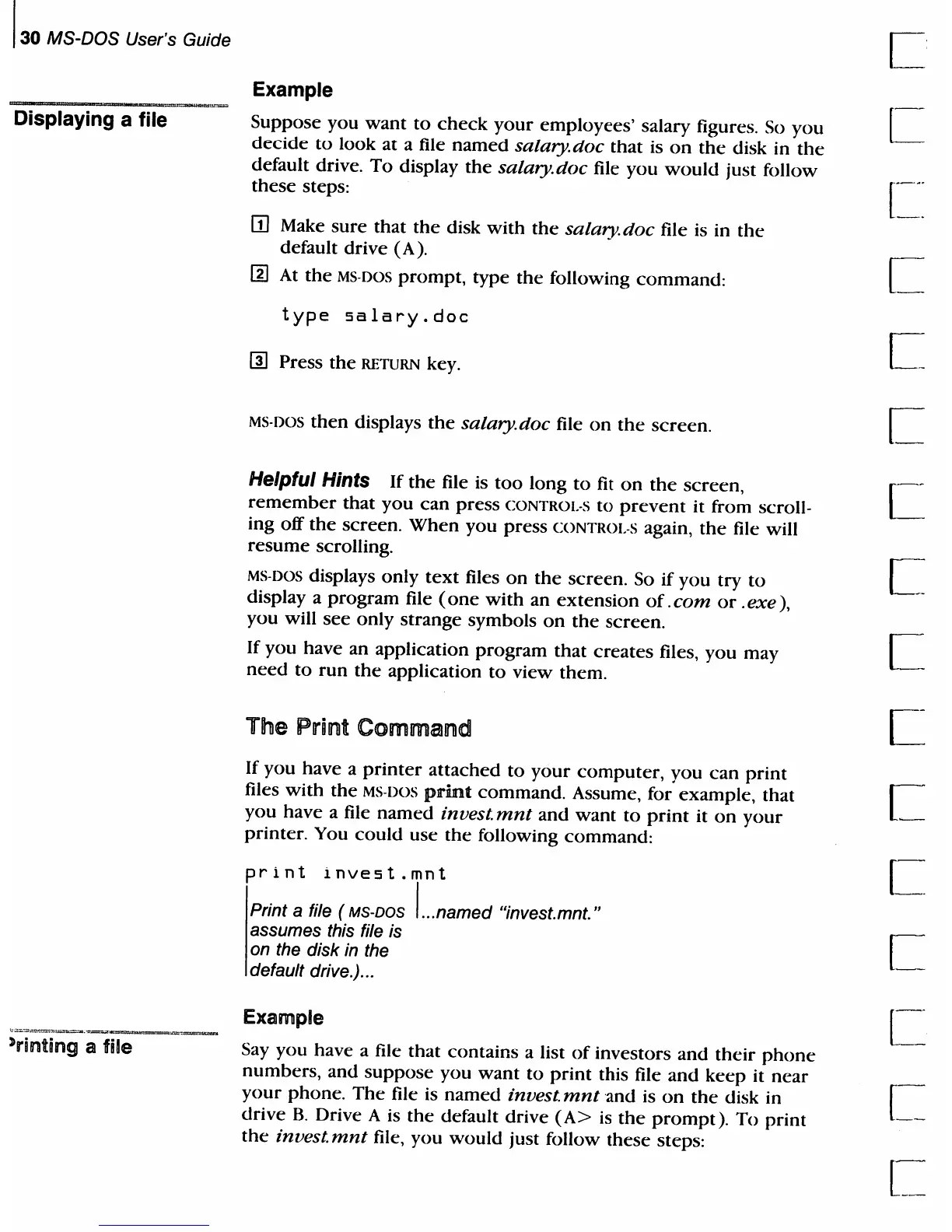
Displaying a file
Example
Suppose you
want
to
check
your
employees'
salary figures. So
you
decide
to
look at a file
named
salary.
doc
that
is
on
the
disk in
the
default drive.
To
display
the
salary. doc file
you
would
just follow
these
steps:
[!]
Make
sure
that
the
disk
with
the
salary.
doc
file
is
in
the
default drive (A).
ill
At
the
MS·
DOS
prompt,
type
the
following
command:
type
salary.doc
[1]
Press
the
RETURN key.
MS·
DOS
then
displays
the
salary. doc file
on
the
screen.
Helpful
Hints
If
the
file is
too
long
to
fit
on
the
screen,
remember
that
you
can
press
CONTROI.·S
to
prevent
it from scroll-
ing off
the
screen.
When
you
press
CONTROI.·S
again,
the
file will
resume
scrolling.
MS· DOS displays only
text
files
on
the
screen.
So
if
you
try
to
display a
program
file
(one
with
an
extension
of.
com
or
.
exe
),
you will
see
only
strange symbols
on
the
screen.
If
you
have an application
program
that
creates
files,
you
may
need
to
run
the
application
to
view them.
If
you have a
printer
attached
to
your
computer,
you
can
print
files
with
the
MS·
DOS
print
command.
Assume, for example, that
you
have a file
named
invest.
mnt
and
want
to
print
it
on
your
printer.
You
could
use
the
following
command:
print
invest.mnt
Print a file (MS-DOS I
..
. named "invest.mnt."
assumes this file is
on
the
disk
in
the
default drive.) ...
Example
'rinting
a
file
Say you have a file that
contains
a list
of
investors
and
their
phone
numbers,
and
suppose
you
want
to
print
this file
and
keep
it
near
your
phone.
The
file is
named
invest.
mntand
is
on
the
disk in
drive
B.
Drive A is
the
default drive
(A>
is
the
prompt).
To
print
the
investmnt
file, you
would
just follow
these
steps:

Table of Contents

Related product manuals