EasyManua.ls Logo

Commodore PC 10 - Filters and Pipes; Command Pipes

Commodore PC 10
494 pages
Print Icon
To Next Page IconTo Next Page
To Previous Page IconTo Previous Page
Loading...
c
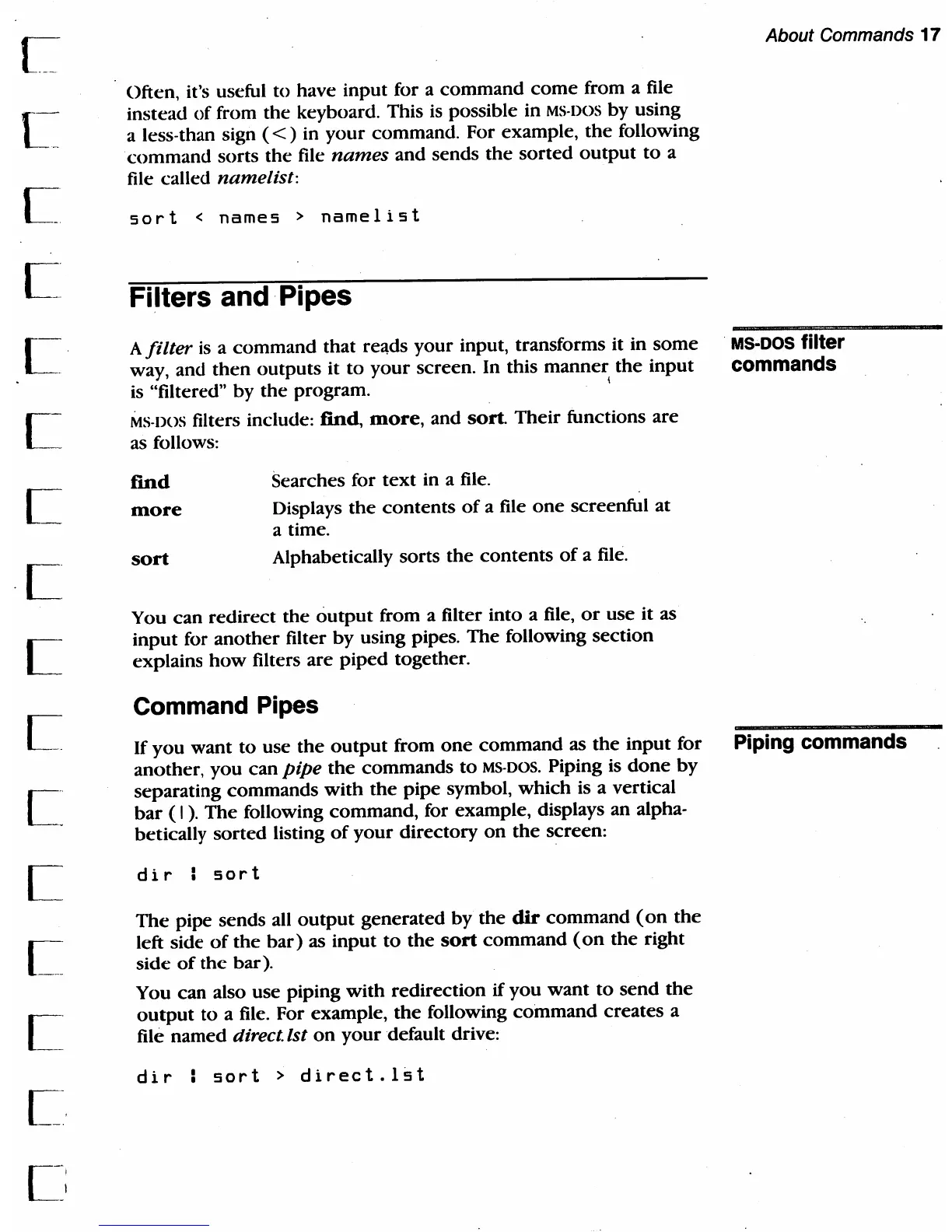
Often, it's useful
to
have input for a
command
come
from a file
instead
of
from
the
keyboard. This
is
possible in
MS-DOS
by using
a less-than sign (
<)
in
your
command. For example,
the
following
command
sorts the file
names
and
sends the
sorted
output
to
a
file called
namelist:
sort
<
names>
namelist
Filters and Pipes
A
filter
is a
command
that reads your input, transforms it
in
some
way, and
then
outputs
it
to
your
screen. In this
manner
the
input
is "filtered" by
the
program. '
MSĀ·
DOS filters include:
find,
more,
and sort.
Their
functions are
as follows:
flnd
more
sort
Searches for
text
in a file.
Displays
the
contents
of
a file
one
screenful at
a time.
Alphabetically sorts
the
contents
of
a file.
You
can
redirect
the
output
from a filter into a file,
or
use
it
as
input
for
another
filter
by
using pipes. The following section
explains
how
filters are
piped
together.
Command Pipes
If
you
want
to
use
the
output
from
one
command
as
the
input
for
another,
you
can
pipe
the
commands
to
MS-DOS.
Piping is
done
by
separating commands
with
the
pipe symbol,
which
is a vertical
bar
( I
).
The
following command, for example, displays an alpha-
betically
sorted
listing
of
your
directory
on
the
screen:
dir
:
sort
The
pipe sends all
output
generated by
the
dir
command
(on
the
left side
of
the
bar)
as
input
to
the
sort
command
(on
the right
side
of
the
bar).
You
can
also use piping
with
redirection
if
you
want
to
send
the
output
to
a file. For example,
the
following
command
creates a
file
named
direct
1st
on
your
default drive:
dir
:
sort>
direct.lst
About Commands 17
MS-DOS filter
commands
Piping
commands

Table of Contents

Related product manuals