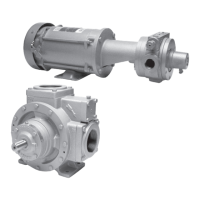
Principles of a Sliding-Vane Pump
Corken’s Coro-Vane
®
pumps are a special type of rotary
positive displacement pump, known as a sliding vane pump.
The sliding-vane pump has many of the positive
displacement advantages of the gear pump, plus the
ability to compensate for wear, and operate at a lower
noise level.
The sliding-vane pump consists of a rotor turning in
a cam (liner) machined eccentrically in relation to the
rotor; thereby displacing the liquid trapped between
the rotor, cam and vanes. Coro-Vane
®
pumps are made
with vanes produced from advanced polymers which
exhibit extremely low coefficients of friction. The vanes
self-adjust for wear and extends the pump life.
Exclusive Features of the
Coro-Vane
®
Pump
The pumping of volatile liquids is one of the most
difficult of all pumping jobs, so more attention must be
given to the design and manufacture of the pump and
to its installation and operation.
In addition to being especially suited for handling volatile
liquids, the Coro-Vane
®
pump has a number of features
to help make it more easily operated and maintained.
Coro-Vane
®
pumps are manufactured in six models:
the Models D51 and F51 small stationary and the
Models 521, 1021, F1021 and F1521 stationary pumps.
The Models F1021 and F1521 have ANSI flanged
connections. All six models have been registered and
listed by the UNDERWRITERS’ LABORATORIES, INC.
for use in the handling of LP-Gas and Ammonia.
The CASE AND HEADS are made of ductile iron for
extra strength and toughness.
The VANES are manufactured of advanced polymers
to provide excellent life and quiet operation. After long
service, the vanes are simply and inexpensively replaced.
Both the CAM and the SIDEPLATES are easily replaced
should the need arise.
The MECHANICAL SEAL is designed for longer life
under greater loads and may be inspected or replaced
without disturbing the piping of the pump. No special
tools are needed.
BEARINGS are heavy-duty roller type for long bearing life.
PRESSURE GAUGE connections, 1/4" pipe thread,
are provided.
The PUMP NOZZLES on Models 521 and 1021 are
equipped with flanges to simplify piping. It is not
necessary to provide unions in the piping system near
the pump because the flanges serve this purpose.
The RELIEF VALVE is built-in as part of the pump on
models 521 and 1021 and is adjustable under pressure.
NOTE: EVEN WITH THIS INTERNAL SAFETY VALVE,
AN EXTERNAL BYPASS VALVE MUST BE INSTALLED.
Chapter 1—Installation Procedures
1.1 Location
The installation of the Coro-Vane
®
pump is simple;
however, in order for the pump to deliver optimum
performance, the principles discussed in this book
should be followed. The piping details in figure 1.2
illustrate methods proved by hundreds of installations.
Your own needs may require slight variations, but every
effort should be made to follow the recommendations
identified in this manual.
No pump can discharge more liquid than it receives, so
the pump location and the inlet piping must be given
careful attention. If the inlet piping is unable to supply
the demand of the pump, you may expect trouble. The
inlet sizes shown in figure 1.2 are the smallest piping
size you can use with success.
For the transfer of flammable liquids like LPG, the pump
must be installed according to the applicable local
safety and health regulations. The installer and/or the
user must take into account the following:
• The pump must be located as near the storage tank as
possible. The complete inlet line, including the vertical
line from the tank must not exceed twelve feet (3.7 m)
in length.
• The bottom of the tank must be no less than two feet
(0.6 m) above the pump inlet nozzle, with four feet
(1.2m) considered standard.
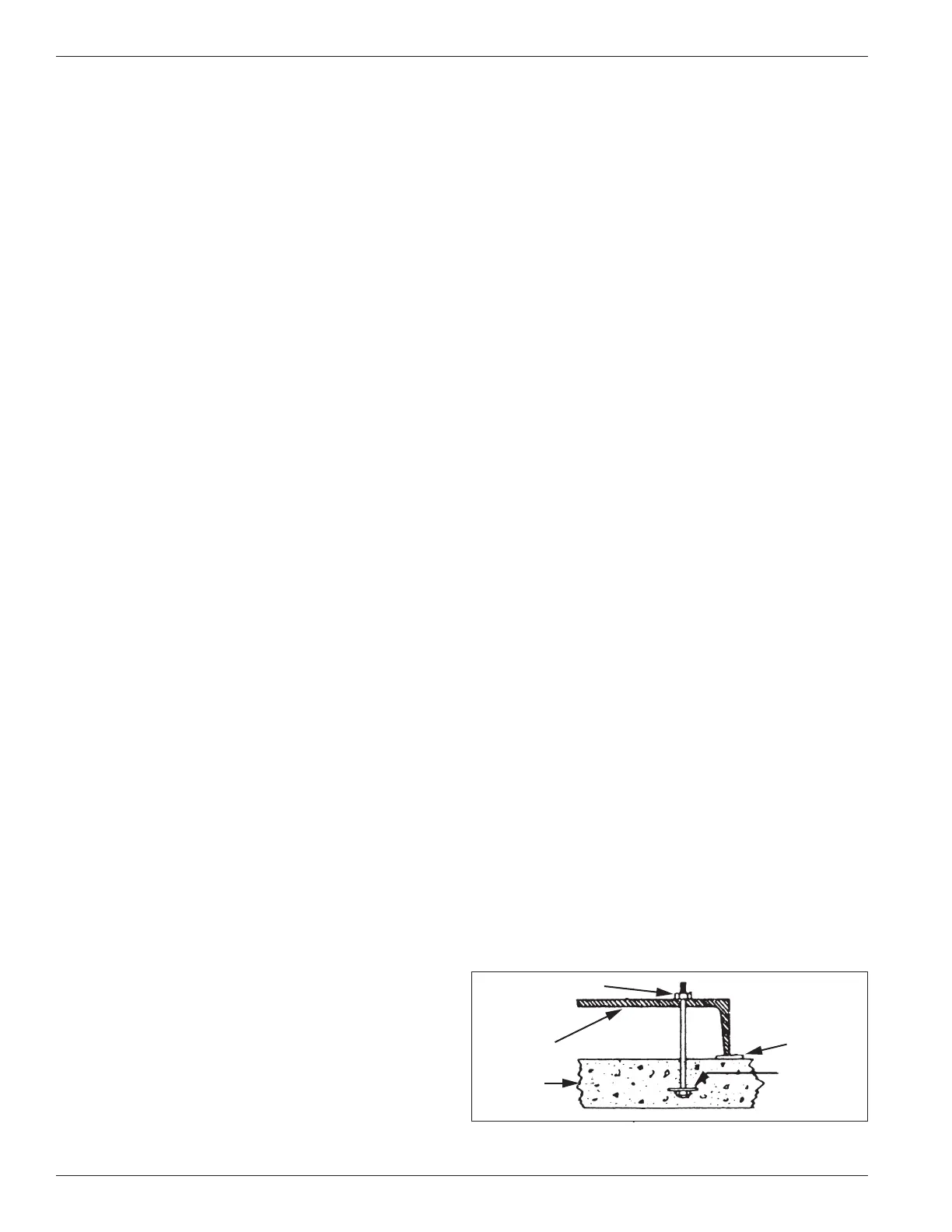
• The foundation for the pump is important. The foundation
must be firm, level and preferably made of concrete. The
suggestions in figure 1.1 should be observed.
Concrete
Large washer
Metal shim
Pump base
1/2" x 8" anchor bolt
Fig ur e 1.1
4



 To Next Page