87
• End an exercise if it becomes uncomfortable
for you and you are no longer able to maintain
general body tension, but end it after no more
than 10 minutes. Listen to your body and do
not overstrain it.
Warming up
Give yourself enough time to warm up each time
you use the product. Some simple exercises to do
this are shown below.
You should repeat each exercise two to three times.
Neck muscles
1. Turn your head slowly to the left and to the
right. Repeat this movement four to five times.
2. Rotate your head slowly, first in one direction,
then in the other.
Arms and shoulders
1. Clasp your hands behind your back and pull
them upwards carefully. If you bend your upper
body forwards at the same time, all your mus-
cles will be maximally warmed up.
2. Rotate both your shoulders forwards at the same
time and then change direction after one minute.
3. Pull your shoulders up to your ears and then let
them drop again.
4. Circle your right and left arms alternately for-
wards and then, after one minute, backwards.
Important: don’t forget to keep breath-
ing steadily!
Exercise routine
You should observe the following the first time you
stand on the product:
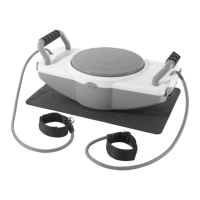
• Familiarise yourself with the product and its
vibration. For instance, test the vibration by
putting just one foot on the vibrating plate
when it is at a low frequency. Then stand on the
product with both feet, and then on tiptoes with
knees bent in order to feel the vibration.
• Always stand on tiptoe first so that the vibration
is absorbed by your calves and thighs.
Checking your pulse
For healthy fitness exercise, it makes sense to
check your own pulse rate regularly.
• Check your pulse even during supposed
passive exercise to prevent health risks due to
excessive exercise.
• From a sports medicine point of view, an exer-
cise heart rate (pulse) of 60% to 85% of your
maximum pulse is optimal.
• The fitter or more exercised your body is, the
slower your pulse rises and the faster it returns
to its resting rate again. To keep track of your
workout progress, record your values regularly
in a chart. You will get the following values
depending on when you take your pulse:
• Before exercising: resting heart rate
• Immediately after finishing workout (10 minutes):
stress/exercise pulse
• 1 minute after finishing workout: recovery
pulse. Use the following standard values when
checking your stress/exercise pulse:
• Pulse rate 60%: here you are exercising in the
very efficient range of 60%, ideal for beginners.
• Pulse rate 85%: this range of 85% of your
maximum pulse rate is suitable for athletes and
advanced trainers.
• Pulse rate 90%: the anaerobic range of 90% of
your maximum pulse is only suitable for profes-
sional athletes and short exercises.
Taking your pulse
1. Place the index and middle fingers of your right
hand on the inside of your left wrist.
2. When you feel your pulse, count the number of
beats in 15 seconds.
3. Multiply the number of pulse beats you counted
by four.
4. The result is your pulse rate per minute.
5. Compare the pulse rate you have measured
with the limit values applicable to you (see
‘Calculating your exercise pulse’).
Calculating your personal maximum
heart rate
Maximum heart rate = 100%
Formula: 220 minus your age
Calculating your lower and upper
limit for exercising heart rate
Pulse lower limit = 60%
Formula: (220 minus your age = maximum heart
rate) x 0.6
Pulse upper limit = 80%
Formula: (220 minus your age = maximum heart
rate) x 0.8
GB


 To Next Page