25
CroozerCargo14-ENG-2-14
Croozer Cargo Inspections and Maintenance
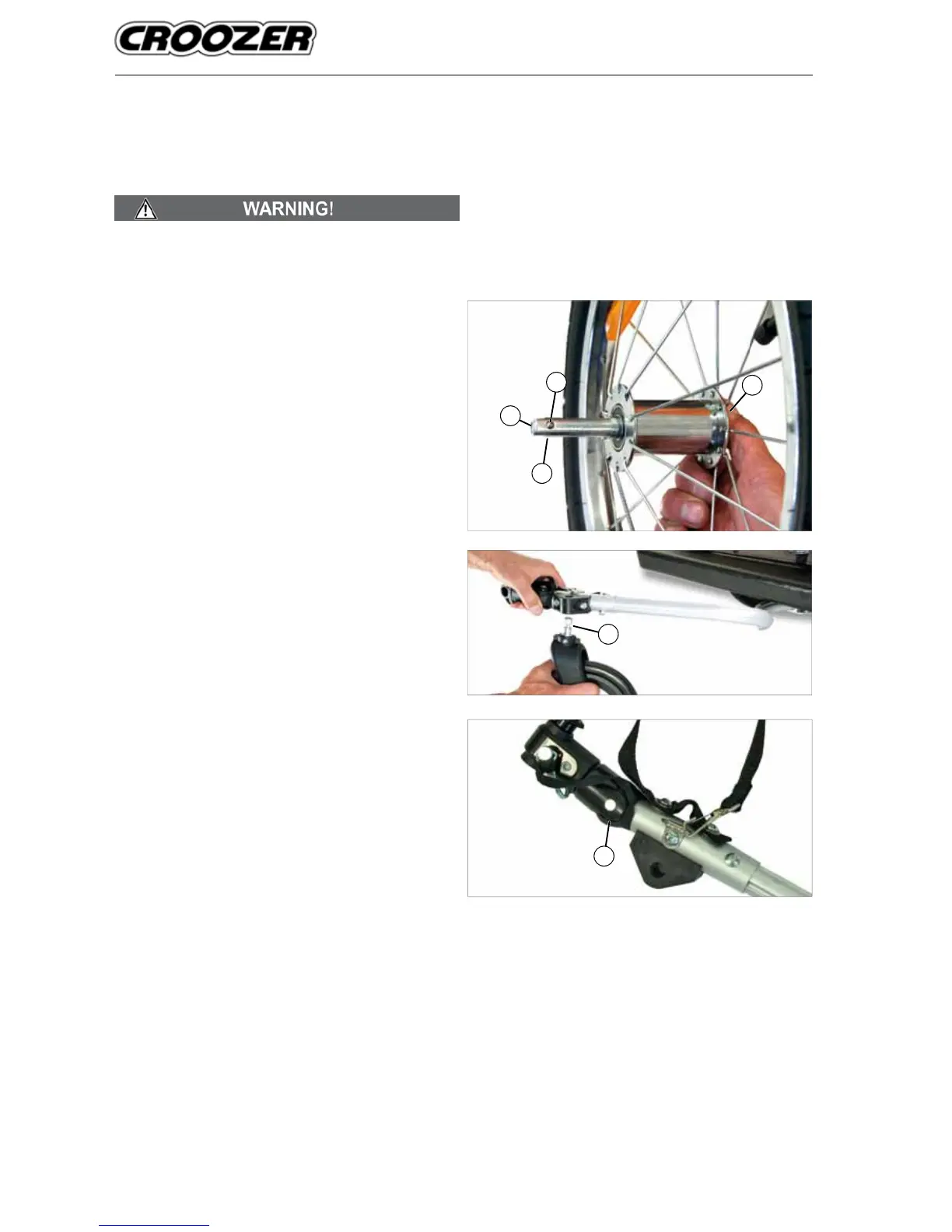
Cleaning and lubricating the wheel axles
The wheels of the Croozer Cargo are equipped with a
special mechanism for easy attachment and removal. The
retaining balls (1) and push-button pins (2) of the axles
must be cleaned and lubricated on a regular basis.
The retaining balls (1) and push-button pins (2) of the
axles must be cleaned and lubricated on a regular basis.
Otherwise, the wheel could fall off while riding, resulting
in accidents with severe injury or death.
1. Wipe off the axle with a clean cloth to remove dirt and
grime.
2. If any dirt or grime remains around the push-button pin
(2) or retaining balls (1), then clean them with a small
brush.
3. Lubricate these parts, and press the push-button (3)
several times to distribute the lubricant evenly. The
push-button pin and retaining balls must be able to
move freely.
4. Use a clean cloth to wipe off any excess lubricant.
Tip: The axle can be lubricated using a bicycle-chain
lubricant.
Servicing the Handcart wheel
To ensure that the Handcart wheel is able to pivot freely
in the necessary direction, silicone spray must be applied
periodically to the swivel stud (4) of the wheel.
Servicing the hitch-connector joint
To prevent damage to the hitch connector, silicone spray
must be applied periodically to the hitch-connector joint (5).
Inspecting the Croozer Cargo after an acci-
dent
If the Croozer Cargo has been involved in an accident,
it must be inspected by a professional bicycle mechanic
before it can be used again, even if there is no visible dam-
age. Accidents can leave behind tiny, and often invisible,
hairline cracks in critical components whose failure would
adversely affect the safety of the vehicle.
3
1
1
2
4
5



 To Next Page