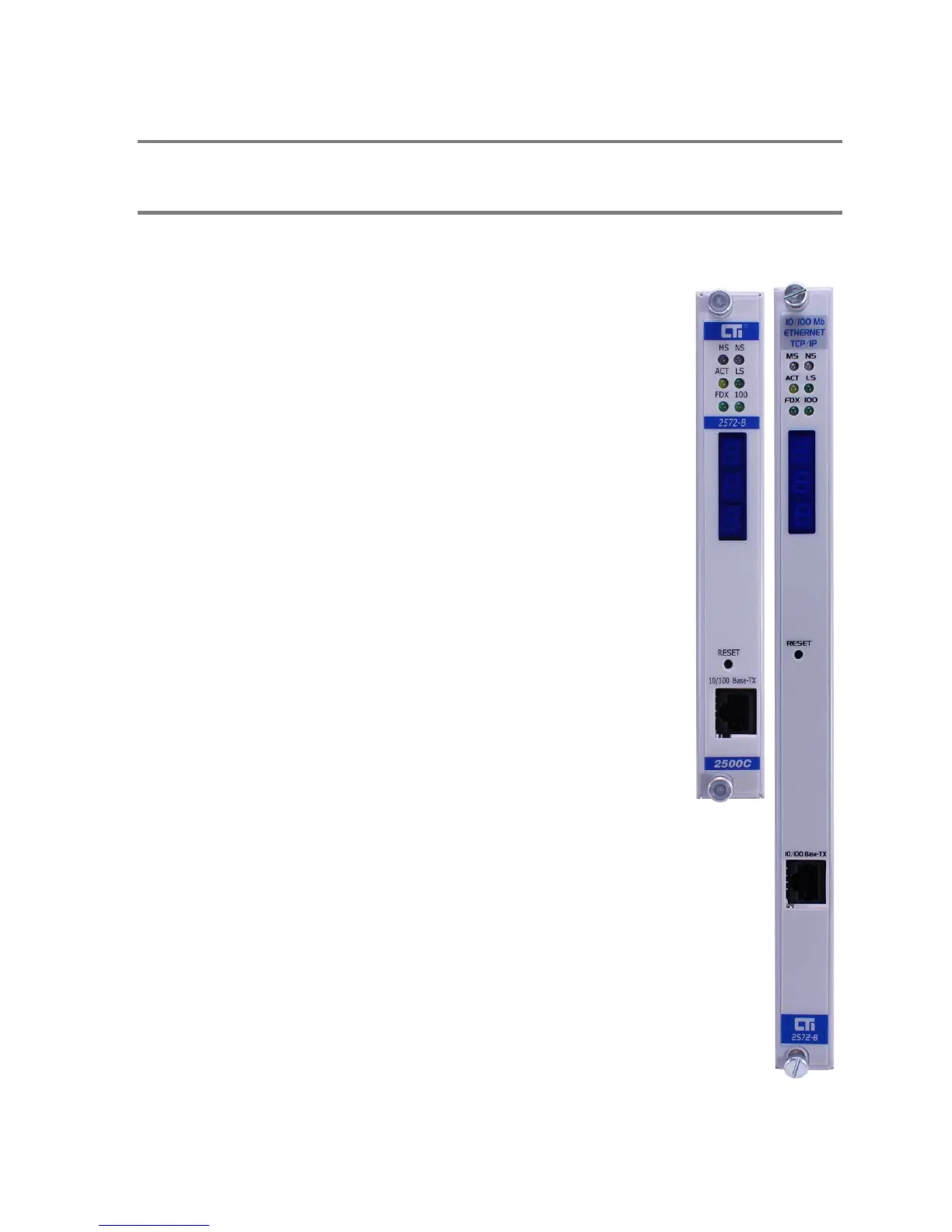
CTI 2572-B / 2500C-2572-B Installation and Operation Manual 1
CHAPTER 1. PRODUCT OVERVIEW
1.1. Introduction
The 2572-B Ethernet TCP/IP module provides network services for CTI 2500 Series®
Classic controllers and Siemens SIMATIC 505® programmable logic controllers. The
2572-B module is designed to install in a CTI 2500 Series classic base or a Siemens
Series 505® base. Employing a new microprocessor and related components, the
2572-B module is a direct replacement for the 2572-A Ethernet TCP/IP module.
The 2500C-2572-B Ethernet TCP/IP module provides network services for CTI 2500
Series® Compact Controllers. The 2500C-2572-B module installs in a CTI 2500 Series
compact base.
Both modules are Special Function modules, which communicate with the PLC using
the SFIO (Special Function I/O) protocol. Network workstations and control devices
can use the services of these modules to read data from the PLC, write data to the
PLC, program the PLC, and exercise supervisory control over the PLC operation. In
addition, PLC logic can use the facilities of the CTI 2572-B and 2500C-2572-B
modules to access data in other CTI 2500 Series® controllers or Siemens SIMATIC
505® PLCs.
The modules support the following communications protocols:
• Camp Server: Allows a client to access PLC data and control PLC operation
using the CTI CAMP or the Siemens Task Code protocols.
• Modbus Server: Allows a client to access PLC data using the Modbus TCP
(Open Modbus) protocol.
• EtherNet/IP Server: Allows Allen Bradley Logix® controllers to read and
write PLC data stored in V memory.
• Camp Client: Allows the PLC to read and write data stored in V memory on other PLCs.
They connect to an Ethernet network via a CAT 5e RJ-45 connector. The network port supports
10Mb or 100Mb Ethernet data link (half or full duplex operation). The firmware includes a full
function TCP/IP stack that supports both TCP and UDP protocols.
The module provides extensive diagnostic facilities, accessible via an embedded web browser, to
aid in the detection and correction of network problems. In addition, the web browser can be
used to configure module operating parameters and to initiate firmware update.



 To Next Page